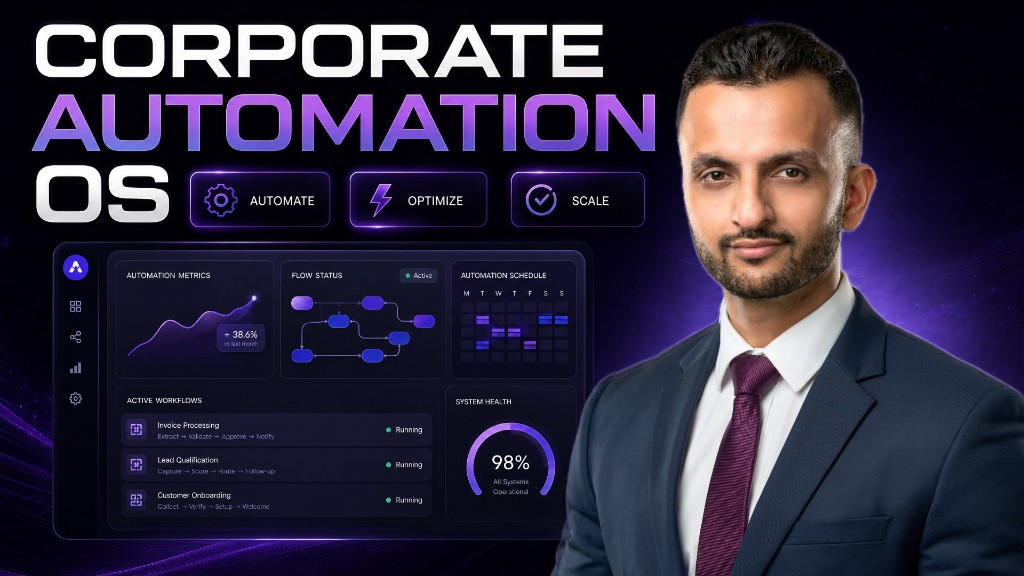
Beyond Chatbots: Building True AI Employees for Transformative Business Growth
In the rapidly evolving landscape of artificial intelligence, the conversation has moved far beyond simple chatbots. For astute entrepreneurs, the focus is now squarely on leveraging AI not merely as a tool, but as a genuine AI employee capable of executing complex business functions, driving efficiency, and unlocking unprecedented growth. This profound shift represents a strategic imperative for any business aiming to maintain a competitive edge.
This guide delves into the methodology of constructing an AI employee from the ground up, differentiating it from lesser AI constructs, and providing a practical framework for integrating these sophisticated agents into your operational fabric using advanced tools and strategic automation principles.
The Evolution of AI: From Chatbots to Autonomous Employees
To truly harness the power of AI, it is crucial to understand the distinct classifications of AI and their varying levels of utility within a business context. Not all AI is created equal, and mistaking a basic conversational tool for a strategic asset can lead to significant misalignment and missed opportunities.
Chatbots: The Reactive Interface
At the most fundamental level, chatbots are reactive programs designed to engage in conversational interactions, typically following pre-defined rules or scripts. Their utility is often confined to answering frequently asked questions, routing inquiries, or performing simple transactional tasks. While useful for basic customer service or initial information dissemination, chatbots lack context, memory beyond a short interaction, and the ability to proactively solve problems or learn from experience. They are an interface, not an employee.
AI Agents: Goal-Oriented Specialists
Stepping up in sophistication, AI agents are designed with a specific goal in mind. These agents can utilize a limited set of tools, access external information, and perform more complex tasks than a chatbot. An AI agent might be tasked with summarizing documents, generating creative content based on a prompt, or even managing simple data entry. They possess a clearer understanding of their immediate objective and can make minor decisions to achieve it. However, they generally lack the persistent memory, the broad array of skill sets, and the deep integration required to act as a truly autonomous business function. They are specialists, often requiring human oversight and specific prompts for each task.
True AI Employees: Autonomous, Adaptive, and Integrated
The pinnacle of business AI application is the true AI employee. This advanced construct transcends the limitations of chatbots and simple agents by embodying a comprehensive set of capabilities that mimic a human counterpart. An AI employee is characterized by:
- Persistent Memory: The ability to retain information, learn from past interactions, and build a long-term understanding of its role, responsibilities, and the business context. This is critical for consistent performance and continuous improvement.
- Defined Standard Operating Procedures (SOPs): Just like human employees, AI employees operate within clearly defined SOPs that dictate their actions, decision-making processes, and compliance requirements. This provides structure, predictability, and accountability.
- Extensive Tool & Skill Integration: AI employees are equipped with a diverse array of skill sets and can seamlessly integrate with and utilize various business tools, APIs, and platforms – from CRMs and project management software to data analysis tools and communication platforms.
- Proactive & Goal-Oriented: They don't just react; they proactively work towards achieving specific business objectives, making independent decisions within their defined scope, and adapting to changing circumstances.
- Seamless Workflow Integration: An AI employee is not an isolated component but an integral part of existing business workflows, collaborating with human teams and other AI systems.
- Performance Monitoring & Reporting: They can connect to dashboards to monitor their own performance, report on key metrics, and even suggest improvements or flag anomalies.
For entrepreneurs, understanding this distinction is paramount. Investing in a true AI employee means acquiring a force multiplier for your operations, capable of automating entire business processes and delivering tangible, measurable value.
The Anatomy of an AI Employee: Key Components for Business Value
Building a high-impact AI employee requires a meticulous approach to its foundational architecture. Each component serves a critical function, contributing to the agent's overall autonomy, effectiveness, and ability to drive business outcomes.
Persistent Memory: The Foundation of Intelligence
Unlike the transient interactions of a chatbot, a true AI employee requires persistent memory. This is not merely a record of recent chats but a structured repository of knowledge, decisions, and learned patterns over time. This memory allows the AI to:
- Maintain context across long-running tasks or relationships (e.g., a customer service AI remembering a client's full history).
- Learn from successes and failures, improving its decision-making and performance.
- Adhere to specific client or business nuances, providing tailored interactions and solutions.
Standard Operating Procedures (SOPs): The Blueprint for Action
Standard Operating Procedures (SOPs) are the digital blueprint that defines an AI employee's role, responsibilities, and operational framework. These are not static instructions but dynamic guidelines that empower the AI to make informed decisions within its specified domain. Effective SOPs for an AI employee include:
- Role Definition: Clearly outlining its function (e.g., "Lead Qualification Specialist," "Tier 1 Support Agent").
- Decision Trees & Logic: Guiding the AI through various scenarios and dictating appropriate responses or actions.
- Escalation Protocols: Defining when and how to involve human counterparts for complex or sensitive issues.
- Compliance & Ethical Guidelines: Ensuring the AI operates within legal and ethical boundaries.
Tool & Skill Integration: Expanding Capabilities
The true power of an AI employee lies in its ability to interact with and leverage a diverse range of external tools and APIs. This tool integration transforms the AI from a conversational entity into an actionable workforce member. Consider an AI employee designed for lead qualification: it might integrate with:
- A CRM to update lead statuses.
- A scheduling tool to book discovery calls.
- An email platform to send follow-up communications.
- A data enrichment service to gather more information on prospects.
This broad skill set allows the AI to perform complex, multi-step tasks autonomously. Tools like OpenClaw and platforms using advanced coding environments like Claude Code become invaluable for building these sophisticated integrations, allowing AI to interact with web pages, databases, and proprietary software just like a human operator.
Dashboards and Data Connectivity: Oversight and Optimization
For entrepreneurs, visibility and control are paramount. An AI employee must connect to dashboards that provide real-time insights into its performance, activity, and impact. This data connectivity enables:
- Monitoring key performance indicators (KPIs) relevant to the AI's role.
- Identifying bottlenecks or areas for improvement.
- Ensuring compliance and ethical operation.
- Justifying the return on investment (ROI) of the AI workforce.
Workflow Integration: Seamless Operation
An effective AI employee does not operate in a vacuum. It must be seamlessly integrated into existing business workflows, collaborating with human teams and other automated systems. This ensures a cohesive operational environment where AI augments, rather than disrupts, current processes.
Practical Framework: Building Your First AI Employee
The journey to building your first AI employee is structured and methodical. It begins with identifying a specific business need and progresses through development, integration, and continuous refinement.
1. Define the Role and Problem Statement
Before any development, clearly articulate the specific business problem your AI employee will solve. What repetitive, time-consuming, or data-intensive task can it manage? Examples include:
- Automated lead qualification and nurturing.
- First-line customer support and issue resolution.
- Data entry and database management.
- Personalized email outreach and follow-ups.
- Market research and sentiment analysis.
A focused problem statement ensures the AI is built with clear objectives and measurable outcomes.
2. Choose Your Foundation: Hardware and Models
The selection of appropriate AI models and underlying hardware is critical. For many business applications, leveraging powerful cloud-based large language models (LLMs) offers a scalable and cost-effective solution without requiring extensive local infrastructure. However, for highly sensitive data or specialized computational tasks, considering dedicated hardware or specific model architectures might be necessary. Tools like OpenClaw or environments that facilitate rapid prototyping with various models (e.g., those compatible with Claude Code) provide the flexibility needed to experiment and optimize.
3. Crafting Intelligent SOPs and Training Data
This is the "brain-building" phase. Translate your defined role into explicit SOPs that guide the AI's decision-making. This involves:
- Mapping out current human processes.
- Identifying decision points and desired outcomes.
- Creating flowcharts and conditional logic that the AI can follow.
While an AI employee learns, initial training data (e.g., past customer interactions, sales scripts, product information) will give it a robust starting point. The quality and comprehensiveness of your SOPs directly correlate with the AI's effectiveness.
4. Integrating Tools and APIs
Connect your AI employee to the necessary business tools and APIs. This might involve:
- Configuring API keys for your CRM, email platform, or project management software.
- Utilizing specialized libraries or frameworks (like OpenClaw) to interact with web applications or perform actions like web scraping.
- Setting up authentication protocols to ensure secure data exchange.
This step transforms the AI from a conversational agent into an active participant in your digital ecosystem.
5. Building the Oversight Dashboard
Develop or integrate a dashboard to monitor your AI employee's activity and performance. This dashboard should track:
- Tasks completed vs. tasks in progress.
- Error rates or instances requiring human intervention.
- Key metrics relevant to its role (e.g., lead conversion rates, customer satisfaction scores).
- Any unusual activity or potential issues.
This provides essential transparency and allows for prompt adjustments and improvements.
6. Iteration and Refinement
The deployment of an AI employee is not a one-time event. It is an iterative process of continuous improvement. Regularly review its performance, gather feedback from human collaborators, and refine its SOPs, skill sets, and integrations. This ensures the AI adapts to changing business needs and consistently delivers optimal value.
Scaling Your AI Workforce: From One Agent to an Autonomous Team
Once you have successfully built and deployed your first AI employee, the potential for scaling your AI workforce becomes immense. The principles of modularity and clear role definition allow you to replicate success and build an entire autonomous team of AI employees, each specializing in different functions.
Imagine a future where:
- One AI employee handles all initial lead qualification.
- Another manages the first tier of customer support across multiple channels.
- A third analyzes market trends and generates insightful reports.
- A fourth automates social media engagement and content scheduling.
These specialized AI employees can even collaborate, passing tasks and information seamlessly between them, forming a highly efficient and intelligent digital workforce. This multi-agent approach not only drives exponential efficiency but also frees your human teams to focus on strategic initiatives, innovation, and tasks requiring high-level critical thinking and empathy.
The Future is Automated, Intelligent, and Collaborative
The advent of the true AI employee marks a significant milestone for businesses ready to embrace the future. It's an opportunity to move beyond basic automation and integrate intelligent, autonomous entities directly into your core operations. For entrepreneurs, this isn't just about cutting costs; it's about unlocking new capacities, achieving unprecedented scalability, and gaining a decisive competitive advantage in an increasingly automated world. The time to build your AI employee team is now.