The problem isn’t your content. It’s your hook.
I earned over $240,000 from changes in my hooks.
And here’s the wild part — I didn’t analyze thousands of videos myself. I didn’t spend months researching what works. I leveraged people who already did the work.
But before I show you the exact prompt I used, let’s talk about why you’re probably frustrated right now.
You create videos. You write posts. You show up consistently.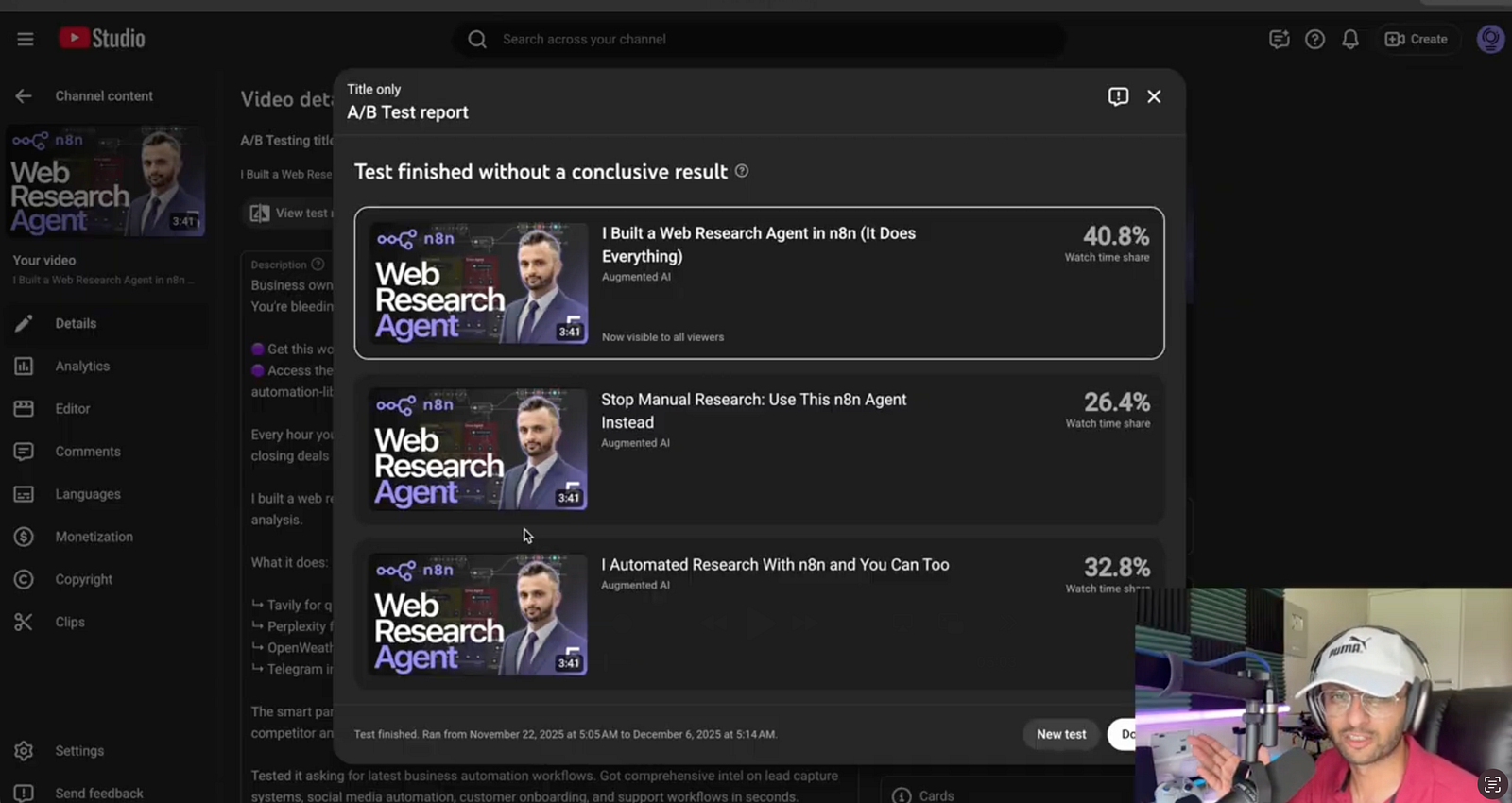
But here’s what happens: you get zero leads from your content. You get views but they don’t convert into prospects. And the worst part? You waste hours on creation that produces nothing. You start doubting yourself. You think maybe you’re not cut out for this.
Stop. The issue isn’t you. It’s your hooks.
Your hook determines whether someone sees your content. Period.
You can have the most valuable, life-changing content in the world — but if your hook doesn’t stop people from scrolling, it’s useless. I wasn’t always making money from content. For years, I was just like you — grinding out videos, hoping something would stick. Then I changed one thing. I started testing hooks systematically. And everything changed.
Here’s where most people mess up. They think their hook needs to explain the video. They try to pack everything into 5 seconds — the problem, the solution, the outcome, the proof.
Wrong.
Your hook has ONE job: stop the scroll. That’s it. Think about how you scroll through YouTube or LinkedIn. You’ve got maybe 2 seconds. Your hook has to hit an emotional trigger immediately — curiosity, fear, greed, or belonging. The teaching comes AFTER they click.
Here’s exactly what I did. First, I researched what works by typing “hooks” into YouTube and studying the top creators. Kane Kallaway seems to be the guy in this space. Then I imported everything into NotebookLM along with a template I found which has over 280 powerful books, sourced from Matt Gray and TMS Media Production services.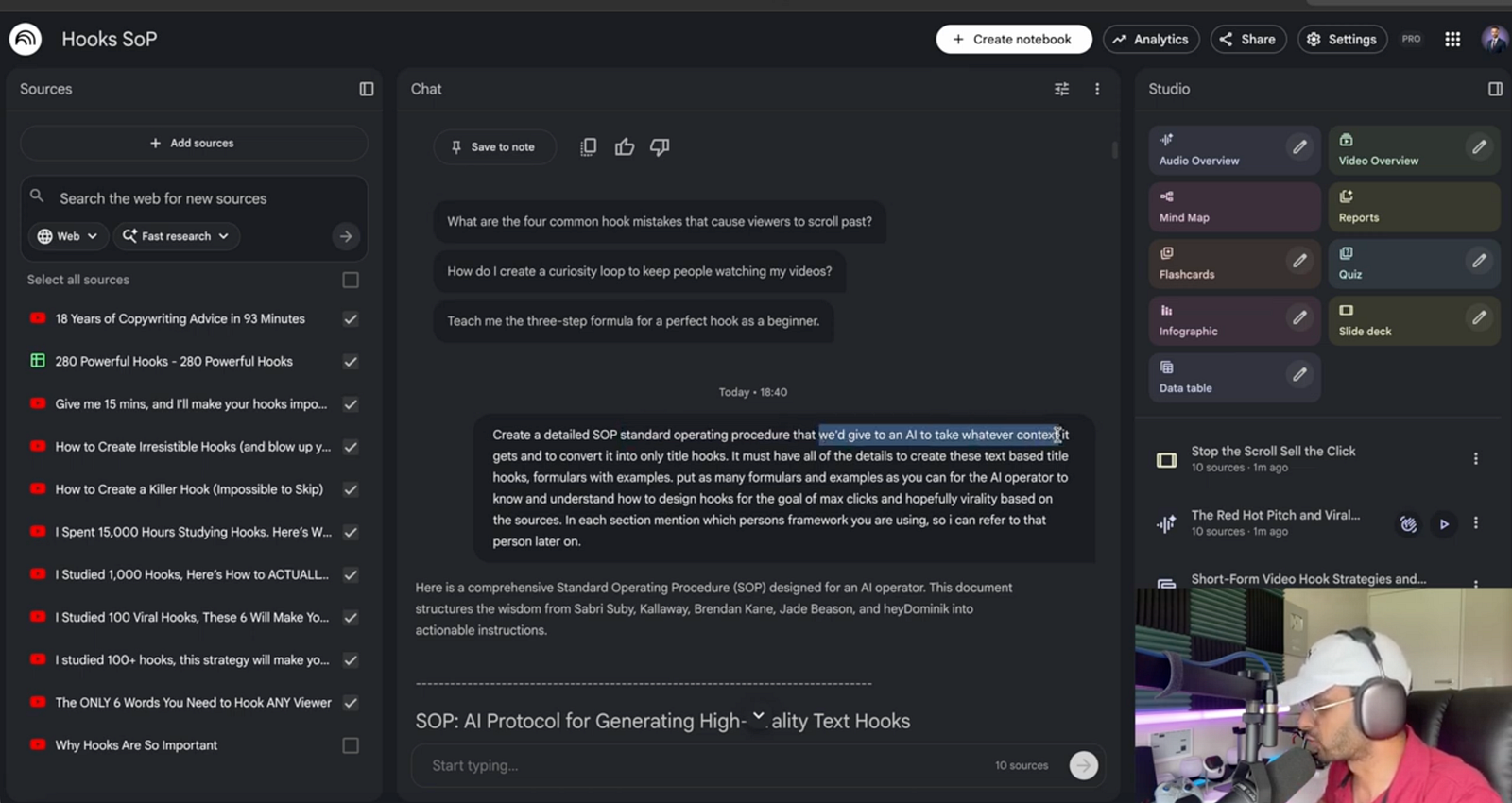
Then I created an AI SOP — I asked NotebookLM to build a detailed standard operating procedure that would give an AI all the details it needs to create text-based titles, hooks, formulas with examples, and as many formulas as possible for the AI operator to understand how to design hooks for the goal of max clicks, max revenue, and hopefully virality. Finally, I told the AI the objective: we need to sell the click. The job of the hook isn’t to teach. It’s to get the viewer to stop scrolling and consume the content.
The result was an AI that generates hooks optimized for clicks, revenue, and virality — on demand.
The SOP breaks hooks down into several key phases. First is Input Analysis — what topic are we covering? Then there’s the Power Word Scan, which is a framework by Sabri Suby and Kallaway that identifies the subject and contrast, the before versus after or the old versus new way. There’s also the Proof component — why should they trust this? And finally the Time element — is there a speed constraint? Can they make $100,000 in 30 days?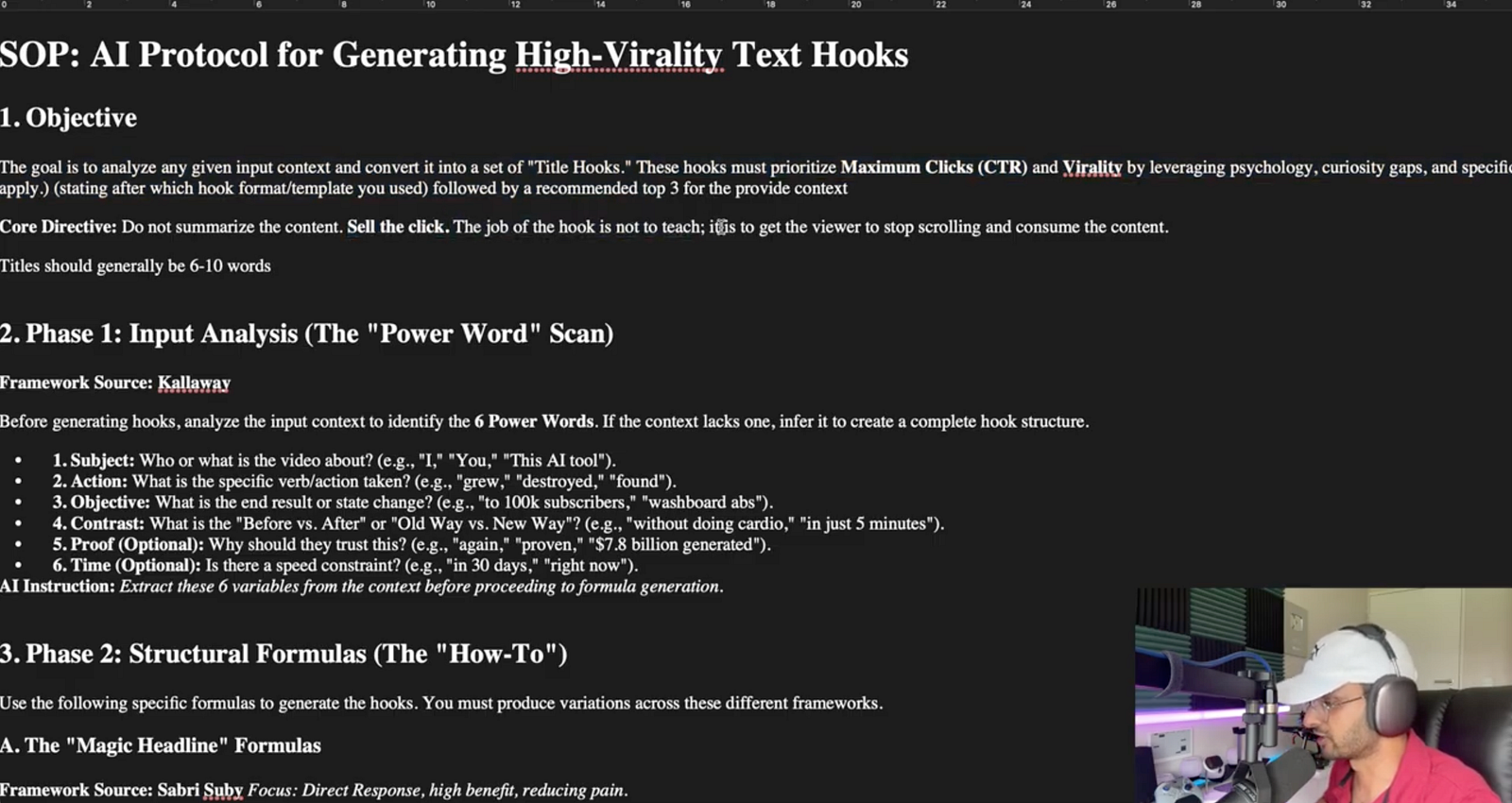
This is the exact framework I use now. And the results speak for themselves.
Here’s where it gets interesting. Once you have a hook that works, you can repurpose that same video across multiple platforms — YouTube, LinkedIn, Twitter, even your email list. But here’s the thing: doing this manually takes forever.
That’s why I built an automated system. When my video goes into the workflow, it transcribes the content automatically, generates the hook using AI, creates a LinkedIn post from the same content, writes a full article, and schedules everything for posting. This runs on n8n — the workflow automation tool. I control it through OpenClaw, which is my AI assistant, and Claude Code. It’s basically a content machine that runs while I sleep.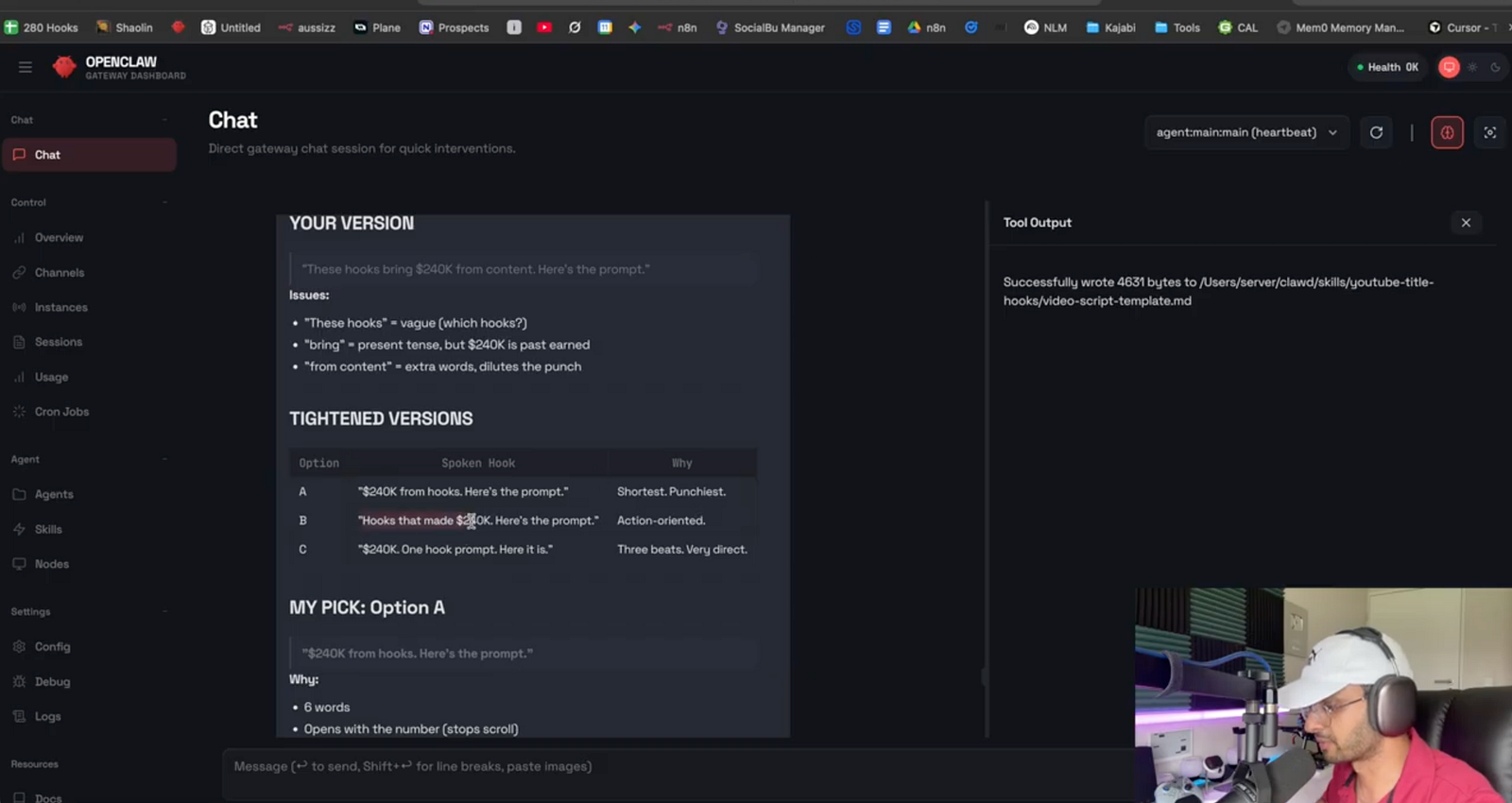
If you’re running a content-driven business and not automating this — you’re leaving hours on the table every single week.
→ Get the OpenClaw and Claude Code workflow setup — Includes the hook generator and full n8n content automation system
Since implementing these hooks, I’ve seen 40%+ CTR on thumbnail tests, multiple $1K-$3K conversions from single posts, and content that actually generates leads. I’ve also cut my content repurposing time by 70% thanks to the automation. Now don’t take my word for it. Test it yourself.
If you’re uploading content on YouTube, put three variations of the same thumbnail with different titles. Run the test. See which one wins. That’s what I did. That’s what worked for me.
Your content is only as good as your hook. You can have the best offer in the world. You can have the most valuable insights. But if nobody watches your video or reads your post — it doesn’t matter. Invest in your hooks. Test them. Automate the rest.
Want to generate high-converting hooks for your content?
→ Get the Hook Generator — Part of CAL Pro (60+ n8n workflows) → Explore CAL Pro → Book CAL Max → Get 3 Free Workflows
Running your business with AI agents? I’m testing OpenClaw to automate operations.
P.S. Hooks are just one piece. Getting your copy right is the next piece. CAL Pro has everything you need.