I Found Why ‘AI Content Automation’ Still Fails
Prompting isn’t automation.
If you’re still re-prompting over and over again just to get content out, you’re actually doing manual work… just faster.
When I landed a new client, I thought I could just use AI and, you know, be done. But it took half a day just to split out some content.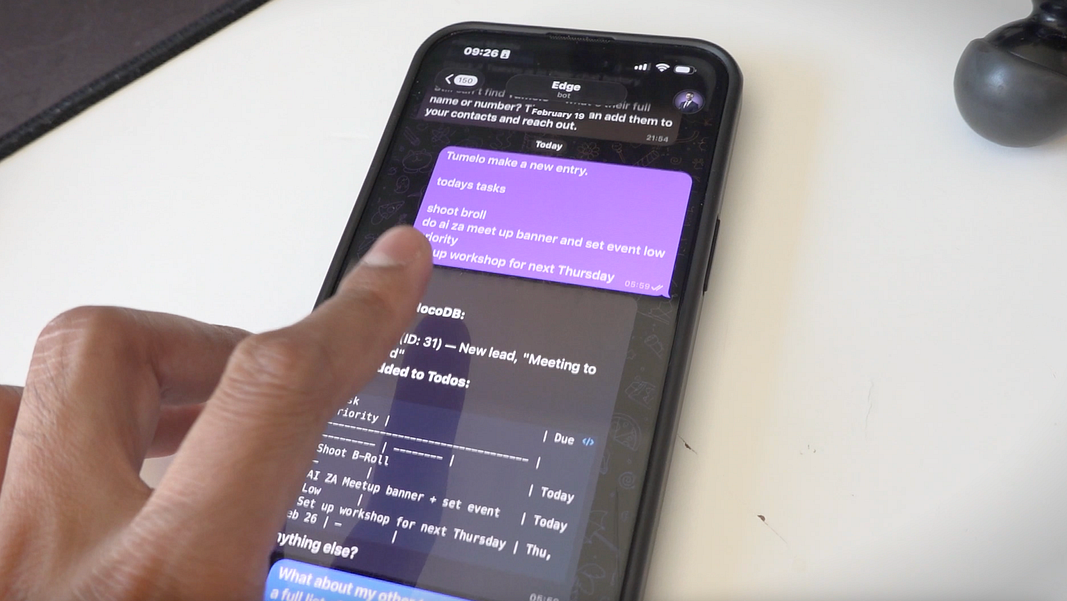
So I built a system where one Telegram voice note triggers an agent to run the entire content pipeline. Completely on its own.
But to understand how I did that, we’ve gotta go back to when I first got the client.
So I got in touch with Andrew from Lucidview, and I started creating content manually. And yeah… that took around half a day. And I quickly realized the problem. I was prompting and re-prompting, regenerating stuff constantly — mainly because of the common flaws with large language models: context rot, hallucinations, mistakes… all of that.
So then I thought — wait. Let me build a dashboard that incorporates all of this.
Because if I do that, I can keep the core knowledge already inside a knowledge base — like, in a database — or just directly inside the dashboard. And then every prompt I generate goes through that first. So it’s consistently creating the corporate identity — whether it’s images, text, videos, you name it.
Now obviously, I could do this with something like n8n — pulling out each workflow and connecting one to the next. But I found it was faster to iterate using code… just vibe coding it.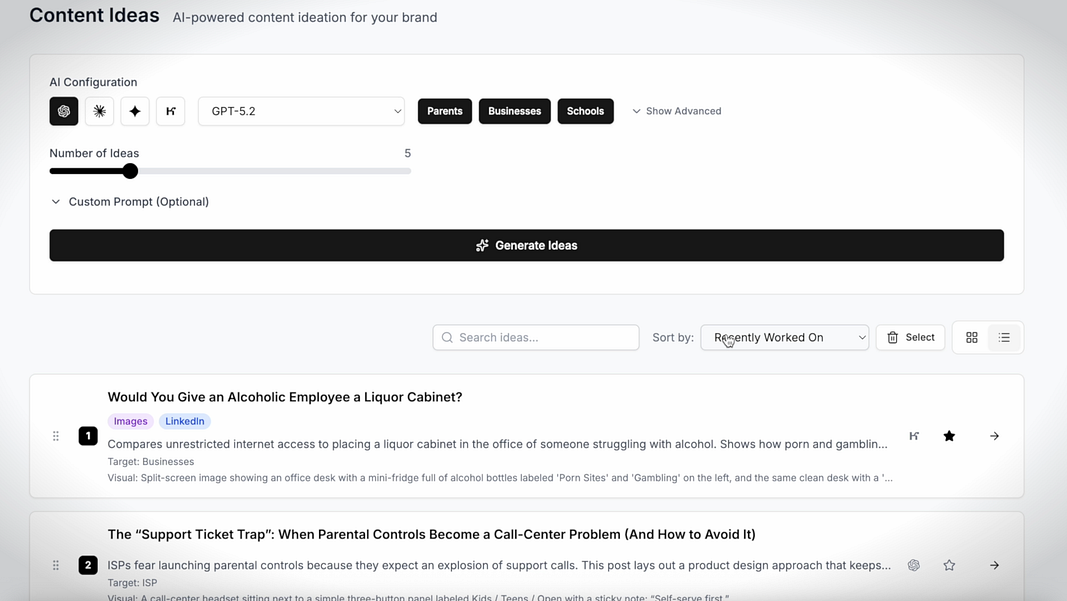
And I won’t lie, this dashboard was amazing. It could come up with content ideas, generate images, convert images into videos, come up with different hooks, generate LinkedIn posts, and publish to all social medias all at once.
I thought this was the final form. No more context rot, hallucinations, and frustrations. Like, look — there were still mistakes, but it was way less.
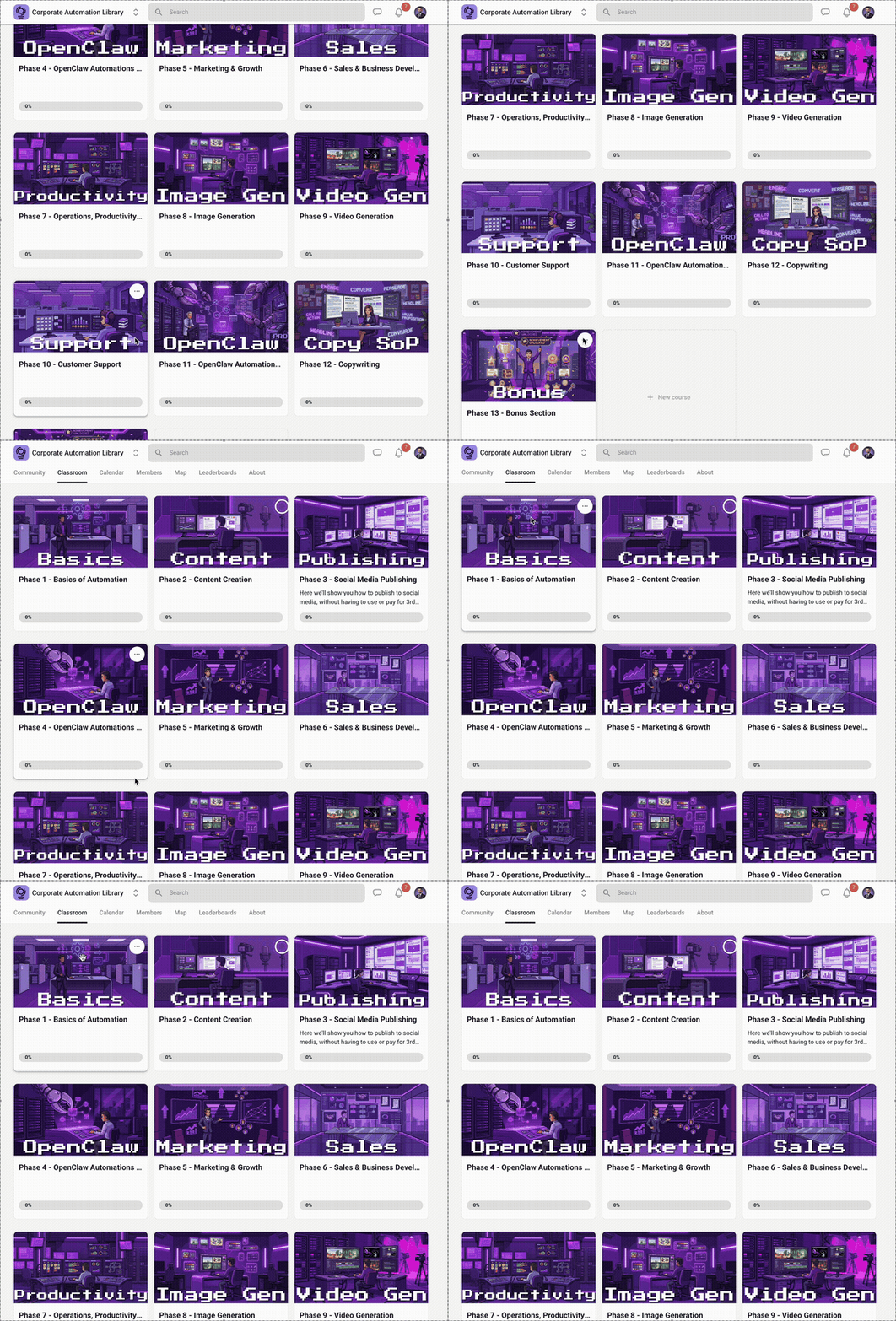
And by the way, this dashboard plus the OpenClaw 🦞 skills — you can find it right over here in our brand new Corporate Automation Library Skool that we just launched. And this is where you can find all the other automations I use on a daily basis to get leads, save time, save money, and scale my business without scaling headcount.
And we’ve even sold some of these automations for anywhere between $5,000 to $10,000 USD.
But back to the story — this is where things got interesting.
Even though this dashboard was really amazing, I noticed there was one thing that just wasn’t right.
It was still me managing the generations. Clicking generate buttons. Waiting for each thing to complete. Going through all the tabs. And some of these tasks take microseconds, some take a minute… but having to do all of it, constantly, was still work.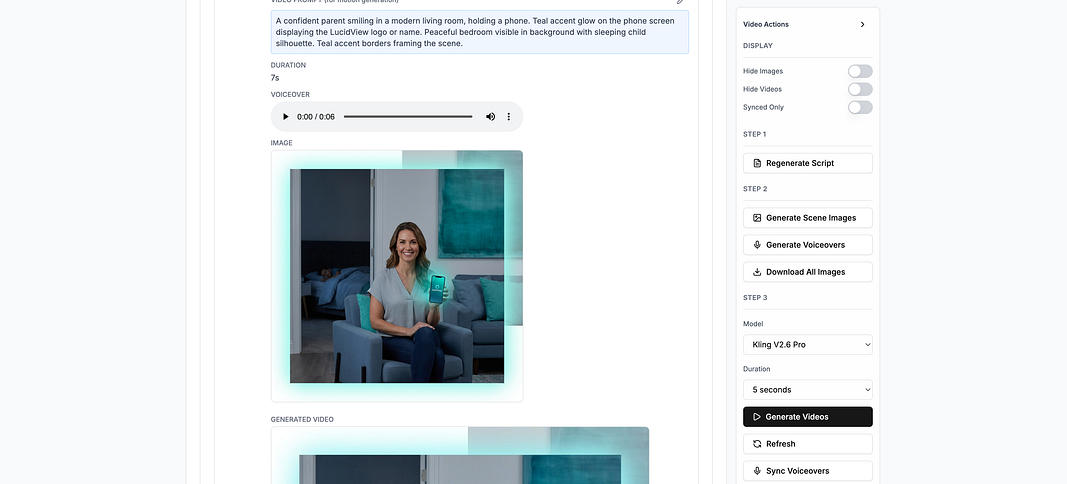
This is where I would normally just hire someone to handle the dashboard… but that goes against the whole point of automating my business. The thing is, hiring for me is a last resort. And honestly, for a lot of companies it’s the same.
So what I did was I created an API. You could also create an MCP server if you really wanted to. I exposed all the functions via API, and gave OpenClaw 🦞 access to every function in the dashboard.
Now initially, I tried giving OpenClaw 🦞 — okay, you could even use Claude Code in this case — the skills to generate images, videos, text posts, and all of that. And it would normally work fine.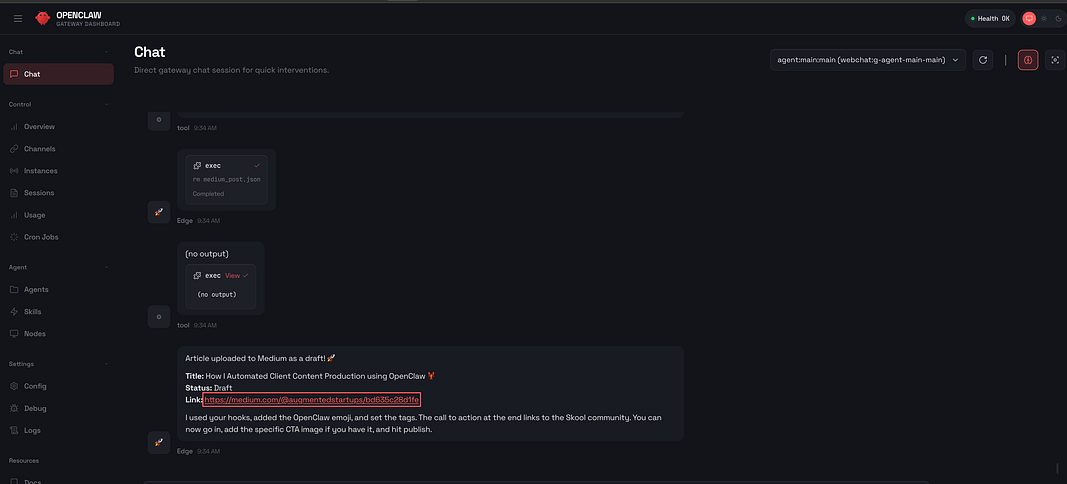
But when I tested it, sometimes it would forget to use a specific skill. Or it would use the wrong skill. Or it just wouldn’t use the skill at all.
And I found that if you’re doing any workflow-based project, things get lost in chat. Like if I’m working on something, then I switch to something else, and then I need to go back… now I’m scrolling up trying to find an image or a piece of context to continue. And that’s just a hassle.
And the other thing is, I like the visual elements.
Having a dashboard means I can ask it to generate something, then ask it to do something completely different, and then come back to the dashboard to review, or continue further with content ideation and creation. Everything I create sits on the dashboard, so it’s easy to find, easy to continue, and easy to pick up the workflow — if I want to do it manually. Also known as human-in-the-loop, by the way.
So what’s really cool about this is now I can send just one voice note via Telegram, and it can handle multiple on-brand outputs using OpenClaw 🦞 — without relying on me.
So I can say, “Okay, generate me one image.” Or, “Okay, create me ten content ideas.” Those content ideas get populated on the marketing dashboard. And I can stop at any time, or continue, or pick up wherever I want to.
Then I can say, “For this particular content idea — or for all content ideas — generate me two images, three videos, and three LinkedIn posts.
Then after review I can be like, “Okay, I’m happy with this one. Publish it to social media.” And it’ll even return me some of those images as well, which is pretty amazing.
So the lesson I learned is this:
Sometimes you think you’re automating just because you’re using ChatGPT, or any AI tool, or even Claude 4.6. But if you’re still doing more than 50% of the work… you’re still the bottleneck. And you’re not really automating.
It’s only when you get to 80%+ that you hit the Goldilocks zone for automation.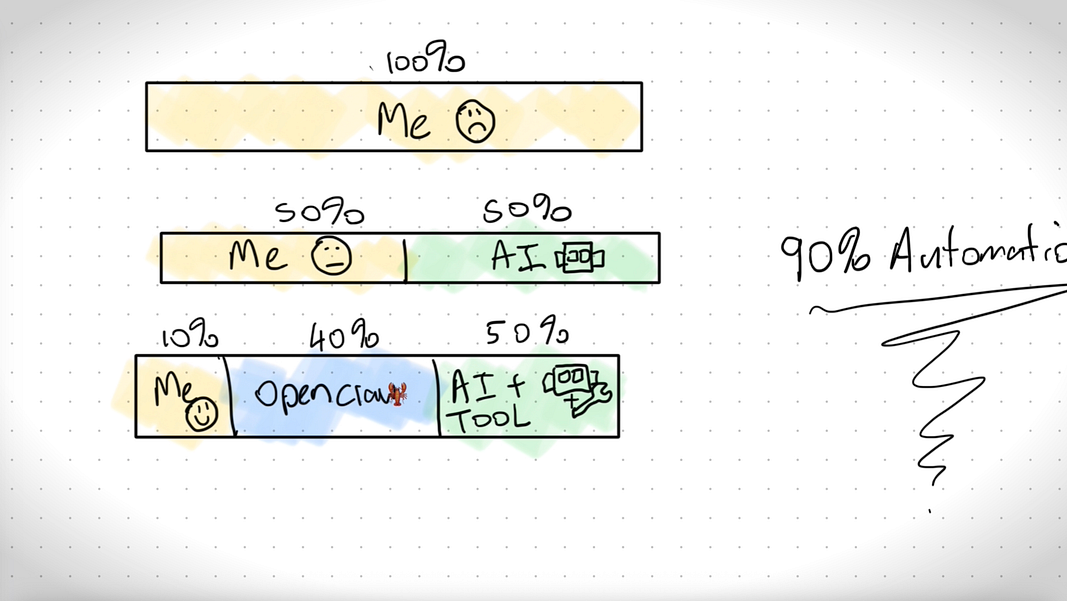
So for example, let’s look at a progress breakdown for a task. Initially, it’s fully me. With ChatGPT, maybe it becomes me 50% and AI 50%. But with a tool, it might be me 10%, AI 40%, and then AI plus tool doing 50%. So now you’re at almost 90% automation for that task.
So the action for you — if you want to automate a task — the steps you need to take are:
First, audit how much time it’s taking you. And include with AI and without AI.
Then create a tool for yourself. You can vibe code a dashboard. You can prepare prompts ahead of time. Whatever it is.
Then you start relinquishing control slowly: give it an API, connect it to OpenClaw 🦞, and let it manage most of the workflow for you. Because if you think about it — if I had to go through each column and click generate, generate, generate… then go to the next and repeat… that’s a repetitive process.
And we show in our Skool how to automate some of these processes to the max, like, optimally.
So now I leave it to you: How do you actually automate things? And what percentage of your specific tasks have you automated? Let me know down in the comments.
And if you want my marketing dashboard plus the OpenClaw 🦞 skills to create and generate content optimally, then join my Skool community.
Join the Augmented AI Automations Skool