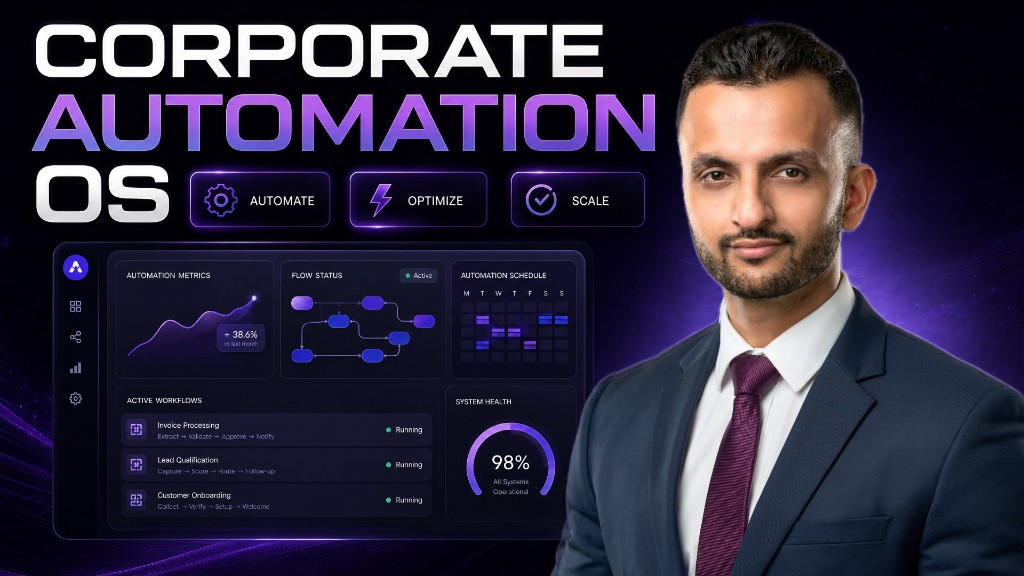
Unleashing Exponential Growth: Your Guide to Building an Autonomous AI Employee
In today's rapidly evolving business landscape, the quest for sustained growth often encounters a fundamental bottleneck: the limitations of human capacity. Traditional scaling models invariably involve scaling headcount, a process fraught with escalating costs, recruitment challenges, and the inherent inconsistencies of human performance. At Augmented AI Automations, our mission, spearheaded by Ritesh Kanjee, is to empower entrepreneurs and business owners to scale revenue without scaling headcount through the strategic implementation of intelligent automations.
Imagine a workforce that never tires, never takes leave, and executes tasks with unwavering precision, 24/7. This is the promise of the Autonomous AI Employee, a digital innovation poised to revolutionize how businesses operate. We've seen firsthand the transformative power of these systems, working with diverse organizations from corporate giants like Momentum to academic institutions like Swana University of Technology, building sophisticated RAG (Retrieval Augmented Generation) and offline large language model systems. This guide will demystify the concept of the AI employee and provide you with a framework to build your very first one.
Why Invest in an Autonomous AI Employee? The Unmatched Advantages
The decision to integrate AI into your workforce goes beyond mere technological adoption; it's a strategic imperative for future-proofing your business. While the idea of a digital colleague might seem futuristic, the practical benefits are immediate and profound.
Human employees, with all their invaluable creativity and problem-solving skills, are subject to natural limitations. They experience fatigue, require sleep and time off, and can be prone to distractions. These factors, while entirely human, introduce variability and potential bottlenecks into critical business processes. An Autonomous AI Employee, however, offers a compelling alternative:
- Unwavering Consistency and Accuracy: AI systems, once trained and programmed, execute tasks with identical precision every single time. This eliminates human error, ensures adherence to protocols, and delivers a consistent customer or operational experience, significantly faster than manual processes.
- Infinite Scalability at Minimal Cost: One of the most significant differentiators of AI employees is their ability to scale on demand. Need to handle a sudden surge in sales inquiries? Simply duplicate your AI sales agent. Unlike human hires, where each new addition requires individual recruitment, onboarding, training, and ongoing salary and benefits, an AI can be replicated almost instantly. This dramatically reduces the cost and time associated with expanding your operational capacity.
- Optimized Efficiency and Resource Allocation: By automating repetitive, rule-based, or high-volume tasks, AI employees free up your human team to focus on higher-value activities that require uniquely human attributes like critical thinking, creativity, complex problem-solving, and emotional intelligence. This means your existing headcount becomes more productive, driving efficiency without the need for additional hires.
- Reduced Operational Costs: The long-term cost savings associated with AI employees are substantial. Beyond salaries and benefits, consider the reduced overheads related to office space, utilities, training materials, and administrative support for human staff. AI operates digitally, requiring only computational resources.
- 24/7 Uninterrupted Operation: Business doesn't stop, and neither does a digital employee. AI can work around the clock, processing tasks, answering queries, and monitoring systems even outside traditional business hours, ensuring continuous operation and responsiveness.
The ability to scale your operations without increasing headcount is no longer a futuristic vision; it's a tangible reality that forward-thinking entrepreneurs are already leveraging.
What Can an Autonomous AI Employee Do for Your Business? Practical Applications
The versatility of autonomous AI systems means they can be deployed across almost every facet of your business. While the specific "role" of an AI employee will vary based on your needs, here are some common and impactful applications:
- Sales & Lead Generation:
- Lead Qualification: Automatically screening inbound leads based on predefined criteria, scoring them, and routing only qualified prospects to your human sales team.
- Personalized Outreach: Crafting and sending customized email sequences or social media messages to prospects, following up autonomously based on engagement.
- CRM Updates: Automatically logging interactions, updating contact details, and scheduling follow-up tasks within your customer relationship management system.
- Customer Service & Support:
- First-Tier Support Bots: Handling frequently asked questions (FAQs), guiding customers through troubleshooting steps, and resolving common issues via chat or email, reducing ticket volume for human agents.
- Information Retrieval: Quickly pulling relevant information from your knowledge base to assist both customers and human agents.
- Sentiment Analysis: Identifying customer frustration or satisfaction in real-time to escalate urgent cases or provide proactive support.
- Marketing & Content Creation:
- Content Generation: Drafting blog post outlines, social media captions, email newsletters, or product descriptions based on prompts and existing brand guidelines.
- SEO Optimization: Analyzing keywords and suggesting content improvements to boost search engine rankings.
- Ad Campaign Management: Optimizing ad spend, adjusting bids, and refining targeting parameters based on real-time performance data.
- Operations & Administration:
- Data Entry & Management: Automating the transfer of data between systems, eliminating manual input errors and saving countless hours.
- Report Generation: Compiling data from various sources and generating regular performance reports, dashboards, and analytics.
- Invoice Processing: Automating the creation, sending, and tracking of invoices, integrating with accounting software.
- Scheduling & Coordination: Managing calendars, scheduling meetings, and sending reminders for team members and clients.
The key is to identify repetitive, high-volume tasks that currently consume significant human effort but do not require complex judgment, empathy, or creativity. These are ideal candidates for AI automation.
Building Your First Autonomous AI Employee: A Step-by-Step Framework
Building an autonomous AI employee doesn't require you to be a coding genius, but it does demand a clear understanding of your business needs and a structured approach. Here's a foundational guide to get you started:
Step 1: Define the Role and Objective (The "Why" and "What")
Before you build, you must define. What specific problem will this AI solve? What are its key performance indicators (KPIs)?
- Identify a Specific Pain Point: Choose a narrow, well-defined task or process that is repetitive, time-consuming, or prone to human error. Examples: "Qualify inbound sales leads," "Answer customer FAQs about product XYZ," "Automate data entry from web forms into CRM."
- Outline Clear Goals: What does success look like? Define measurable outcomes. For lead qualification, it might be "reduce unqualified leads passed to sales by 50%" or "increase sales team efficiency by 20%."
- Map the Existing Process: Document the current manual steps involved in the task. This will highlight where the AI can intervene and optimize.
Step 2: Identify Data Sources and Necessary Tools (The "Inputs" and "Ecosystem")
An AI employee needs information to operate and tools to interact with the world.
- Determine Data Requirements: What information does the AI need to perform its job? This could be customer data, product specifications, pricing lists, past communications, internal knowledge bases, website content, or external market data.
- Identify Integration Points: Which existing software systems will your AI need to interact with? Common examples include:
- CRM (e.g., Salesforce, HubSpot): For customer data, lead management.
- Email Platforms (e.g., Outlook, Gmail): For sending and receiving communications.
- Communication Tools (e.g., Slack, Teams): For internal alerts or team collaboration.
- Database Systems: For storing and retrieving structured information.
- Web Scrapers/APIs: For gathering data from external websites or services.
- Select an Automation Platform: These platforms provide the 'glue' that connects different tools and enables the AI to take action. Popular choices include:
- Zapier, Make (formerly Integromat): For no-code/low-code integrations and workflows.
- Custom Python Scripts/APIs: For more complex, bespoke integrations (often with developer assistance).
- Dedicated AI Automation Platforms: Emerging tools specifically designed for AI agent orchestration.
Step 3: Choose the Right AI Core (The "Brain")
The heart of your autonomous AI employee will likely be a Large Language Model (LLM), especially for tasks involving natural language understanding and generation.
- Leverage Foundational Models: Consider established LLMs like OpenAI's GPT series (GPT-3.5, GPT-4), Anthropic's Claude, Google's Gemini, or open-source alternatives like Llama.
- Fine-tuning vs. Prompt Engineering: For many business applications, prompt engineering (crafting precise instructions for the LLM) can achieve excellent results without the need for extensive fine-tuning. However, for highly specialized tasks or sensitive data, fine-tuning a model on your specific internal data can enhance accuracy and relevance.
- Consider Specialized AI Services: For tasks like image recognition, sentiment analysis, or advanced data extraction, you might integrate dedicated AI services from cloud providers (AWS AI/ML, Google Cloud AI, Azure AI).
Step 4: Design the Workflow and Logic (The "Instructions")
This is where you define how your AI employee will operate, its decision-making processes, and its sequence of actions.
- Map the Decision Tree: Create a flowchart or sequence diagram that illustrates the AI's journey from receiving input to delivering an output.
- Example (Lead Qualification): Receive new lead -> Extract key data (name, company, role, budget) -> Compare data against qualification criteria -> If qualified, send to sales CRM & notify sales rep -> If unqualified, send nurturing email.
- Define Conditional Logic: Specify the "if this, then that" rules that govern the AI's behavior. This ensures it responds appropriately to different scenarios.
- Establish Guardrails and Safety Protocols: What should the AI not do? What happens if it encounters an unexpected input? Define boundaries to prevent unintended actions or incorrect responses.
Step 5: Integrate, Test, and Iterate (The "Deployment" and "Refinement")
Once the core components are designed, it's time to bring them together and ensure they work as intended.
- Connect Your Tools: Use your chosen automation platform (Zapier, Make, custom scripts) to link the LLM with your data sources and target applications.
- Thorough Testing:
- Small-Scale Pilot: Deploy the AI on a limited set of data or in a controlled environment.
- Test Edge Cases: What happens if the input is ambiguous, incomplete, or outside the expected parameters?
- Monitor Outputs: Carefully review the AI's actions and responses for accuracy, relevance, and adherence to your defined logic.
- Iterative Refinement: Based on testing feedback, refine your prompts, adjust your logic, and optimize your integrations. This is an ongoing process.
Step 6: Monitor and Optimize (Continuous Improvement)
An autonomous AI employee is not a "set it and forget it" solution. Continuous monitoring is crucial.
- Performance Tracking: Regularly review the AI's KPIs. Is it meeting its objectives? Are there areas for improvement?
- Feedback Loops: Establish mechanisms for human team members to provide feedback on the AI's performance. This input is invaluable for refinement.
- Adaptation: As your business evolves, so too should your AI employees. Be prepared to update their instructions, data sources, and integrations to keep them aligned with your strategic goals.
Key Considerations for Successful AI Employee Implementation
Beyond the technical steps, successful integration of AI employees requires strategic foresight:
- Start Small, Scale Smart: Don't try to automate your entire business at once. Begin with a single, high-impact task, perfect it, and then expand.
- Human-in-the-Loop: While autonomous, most effective AI systems still benefit from human oversight, especially in the initial stages. Design points where human review or intervention is possible.
- Data Quality and Privacy: AI is only as good as the data it's trained on. Ensure your data is clean, accurate, and that you comply with all relevant data privacy regulations (e.g., GDPR, CCPA).
- Ethical AI: Consider the ethical implications of your AI's actions. Ensure fairness, transparency, and accountability in its operations.
- Change Management: Introduce AI to your human team thoughtfully. Emphasize that AI is a tool to empower them, not replace them entirely, by offloading mundane tasks and enabling focus on more strategic work.
Partner with Augmented AI Automations
The journey to building an autonomous AI workforce can seem daunting, but the competitive advantage it offers is undeniable. By embracing intelligent automations, you're not just cutting costs; you're building a resilient, scalable, and highly efficient business model for the future.
If you're ready to explore how an autonomous AI employee can transform your operations, and you're seeking a fractional automation partner to guide you through the complexities, Augmented AI Automations is here to help. Leverage our expertise and proven methodologies to scale your revenue without scaling headcount. Connect with us today, and let's unlock your business's full potential.