From $5K/Month Agency to Autonomous AI: Revolutionizing Your Content Pipeline
Entrepreneurs today are constantly seeking efficiencies, particularly with the advent of artificial intelligence. Yet, a crucial distinction often gets overlooked: prompting isn't automation. Many fall into the trap of believing they're automating by repeatedly prompting an AI, only to find they're performing manual work, albeit at a slightly faster pace. This is not scaling; it's merely shifting the bottleneck.
At "Augmented AI Automations," we confronted this challenge head-on when a new client, Andrew from Lucid View, came aboard. Our initial attempt to leverage AI for content generation quickly revealed the limitations of a prompt-based approach. What we thought would be a quick win turned into nearly half a day of tedious re-prompting and regenerating content. This experience became the catalyst for building a truly autonomous content pipeline – a system so robust it now effectively replaces the functions of a $5,000 per month agency, triggered by nothing more than a single Telegram voice note.
This journey from manual AI intervention to complete autonomy offers a blueprint for any entrepreneur looking to scale their operations without scaling their headcount.
The Illusion of "AI Automation": When Prompting Becomes a Bottleneck
When we first engaged with Lucid View, the vision was simple: use AI to rapidly produce high-quality content. The reality, however, was far from automated. We spent hours crafting prompts, refining outputs, and battling the inherent flaws of large language models (LLMs). The culprits were familiar:
- Context Drift: LLMs struggle to maintain consistent brand voice and complex requirements across multiple generations, leading to outputs that strayed from the original intent.
- Hallucinations: The tendency of AI to generate plausible but incorrect information necessitated extensive fact-checking and correction.
- Repetitive Mistakes: Even minor errors required constant human oversight, editing, and often, starting over.
This manual, iterative process, while faster than writing from scratch, was still a significant human management bottleneck. We were performing manual work through an AI interface, a far cry from the seamless, scalable solution we envisioned. It quickly became clear that true automation required moving beyond mere interaction with an LLM.
Building the Foundation: A Bespoke AI-Powered Dashboard
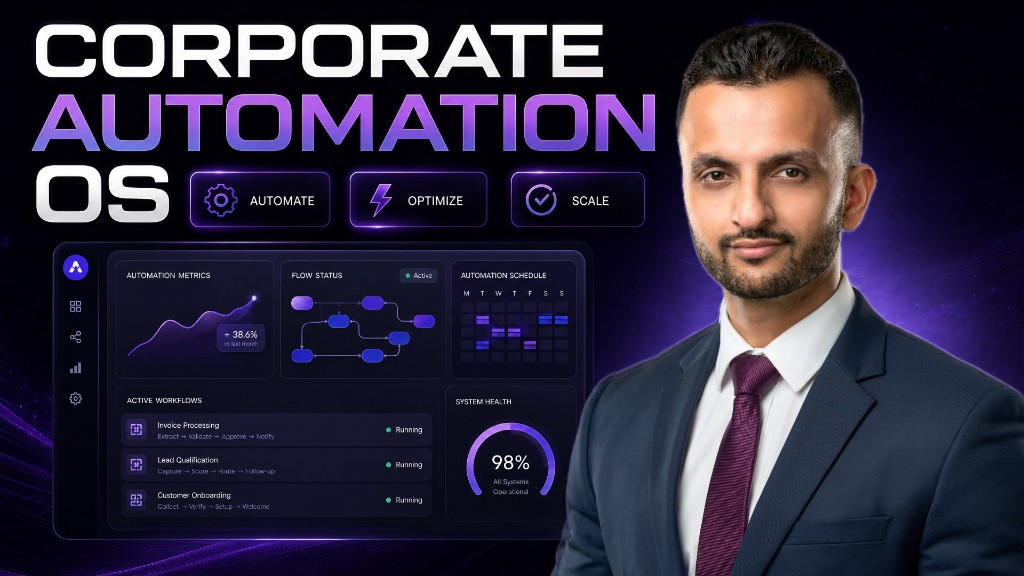
Our first step towards genuine automation was to build a dedicated AI-powered dashboard. Recognizing that direct, one-off prompting was inefficient, we aimed to centralize knowledge, standardize processes, and streamline content generation. Instead of stringing together disparate no-code workflows, we opted for a custom-coded solution, which allowed for unparalleled flexibility and rapid iteration.
This dashboard became the brain of our content operation, capable of:
- Generating Content Ideas: Brainstorming relevant and engaging topics.
- Image Generation: Creating compelling visuals aligned with content.
- Video Conversion: Transforming static images or text into dynamic video content.
- Hook Generation: Crafting captivating introductions for various platforms.
- LinkedIn Post Generation: Tailoring content for professional networks.
- Automated Social Media Publishing: Distributing content across multiple platforms simultaneously.
Crucially, we integrated a comprehensive corporate identity and knowledge base directly into the dashboard. Every piece of content, whether text, image, or video, was first filtered through this knowledge base. This ensured unwavering adherence to brand guidelines, tone, and specific messaging. The result was a dramatic reduction in hallucinations and errors, leading to less frustration and significantly higher quality outputs. We truly believed this was the final form of our automation.
The Next Hurdle: Eliminating the Human-in-the-Loop Bottleneck
Despite the dashboard's immense capabilities, a critical realization emerged: I was still the one managing the generations. I had to click "generate" buttons, wait for each task to complete, and navigate through various tabs to review and finalize. While individual tasks might take microseconds or minutes, the cumulative effect of these human management actions amounted to hours, or even days, per month.
For an entrepreneur committed to automation, this represented a new form of bottleneck. My core principle is that hiring is a last resort for tasks that can be automated. Introducing a human to manage the dashboard, however efficient, ran counter to the very essence of scaling without scaling headcount.
The solution lay in elevating the dashboard from a powerful tool to an autonomous agent.
Unleashing True Autonomy with OpenClaw via API Integration
To achieve full autonomy, we exposed all of the dashboard's core functions via a custom API. This allowed external agents to programmatically access and control every feature. Our choice for this external orchestration layer was OpenClaw, an advanced AI agent designed for complex workflow management.
Initially, we experimented with giving OpenClaw direct access to individual skills like image generation, video creation, and text posts. While functional, it revealed a common challenge with complex, workflow-based projects: workflow context can easily get lost. OpenClaw might occasionally forget to use a specific skill or struggle to maintain continuity if required to navigate back and forth between tasks. The visual and interactive nature of the dashboard remained critical for review and intervention.
The breakthrough was realizing that OpenClaw shouldn't replace the dashboard but rather orchestrate it. The dashboard acts as the reliable, persistent workspace where all content resides, making it easy to find, easy to continue, and easy to pick up on the workflow, even for human-in-the-loop interventions. OpenClaw, through the API, became the intelligent conductor, commanding the dashboard to execute multi-step content pipelines.
The Ultimate Content Pipeline: From Voice Note to Multi-Platform Publishing
The current iteration of our system is a testament to true automation. It's triggered by a single Telegram voice note, transforming a simple command into a cascade of sophisticated, on-brand outputs.
Imagine this scenario: I send a voice note stating, "Create 10 content ideas, and for each, I want videos, LinkedIn posts, images, and SEO-optimized articles."
Here's how the system springs into action:
1. Idea Generation: OpenClaw interprets the voice note and instructs the dashboard to populate 10 distinct content ideas, all adhering to the corporate identity.
2. Dashboard Centralization: All generated ideas immediately appear on the marketing dashboard, providing a visual overview and a point for review or manual intervention if desired.
3. Asset Generation: With a subsequent voice command (e.g., "For these ideas, generate two images, three videos, and three LinkedIn posts"), OpenClaw triggers the dashboard's various modules. It creates customized videos, designs brand-compliant images, and drafts engaging LinkedIn posts for each idea.
4. Review and Approval: I can review the generated assets on the dashboard at any point, providing feedback or making edits if necessary. The human-in-the-loop capability ensures ultimate control and quality.
5. Multi-Platform Publishing: Once approved, a final voice command like, "Publish it all to social media," initiates distribution. Because all our accounts (LinkedIn, TikTok, Instagram, X, YouTube) are linked, the content is automatically pushed to every relevant platform.
6. Confirmation: As an added convenience, some of the generated images are even returned directly to Telegram, confirming the system's execution.
This entire pipeline, from initial ideation to multi-platform publishing, runs autonomously, reliably producing high-quality, on-brand outputs without direct human intervention after the initial command.
The Goldilocks Zone of Automation: Beyond 80%
The profound lesson from this journey is clear: true automation isn't about using AI; it's about eliminating yourself as the bottleneck. If you're still doing more than 50% of the work, you're not automating; you're just using a slightly faster manual tool.
The Goldilocks zone for automation begins when you achieve 80% or more automation for a given task. This is where you unlock exponential gains in efficiency and scalability.
Consider a breakdown of progress:
- Initial Stage: You perform 100% of the work.
- Basic AI Integration (e.g., ChatGPT): You perform 50% of the work, AI performs 50%. This is an improvement but still heavily reliant on your input.
- Advanced AI Automation (Dashboard + OpenClaw): You perform as little as 10% of the work (primarily review and strategic direction). OpenClaw handles 40% (orchestration), and the AI tool within the dashboard handles the remaining 50% (generation). This brings your automation level to an impressive 90% for that particular task.
Your Automation Blueprint: Actionable Steps for Entrepreneurs
For entrepreneurs aiming to reach this Goldilocks zone and truly scale, here are the actionable steps:
1. Audit Your Time: Begin by meticulously tracking how much time a specific task currently consumes, both with and without your current AI tools. This baseline is crucial for measuring future impact.
2. Create a Tool: Develop a dedicated tool or dashboard. This could be a custom-coded application, a sophisticated no-code solution, or even a highly structured system of pre-prepared prompts and templates. The goal is to encapsulate your knowledge base and workflow logic.
3. Relinquish Control Slowly: Start by exposing the functions of your tool via an API. This allows an external AI agent to interact with and manage your processes programmatically.
4. Connect to an Orchestration Agent: Integrate an advanced AI agent like OpenClaw (or similar tools) to manage the majority of the workflows. This agent will interpret your high-level commands and translate them into a sequence of actions for your tool.
5. Target Repetitive Processes: Identify and prioritize highly repetitive tasks within your business. These are the prime candidates for maximum automation impact. The more consistent the inputs and desired outputs, the easier and more effective the automation will be.
By following this blueprint, you can transform your operations from a series of manual AI interactions into a fully autonomous, intelligent content pipeline. This isn't just about saving time; it's about building a business that can scale indefinitely without the traditional constraints of increased headcount and operational overhead.
How are you automating your business, and what percentage of your critical tasks have you already automated? The future of scalable entrepreneurship lies in embracing these advanced automation strategies.