
Last updated: 22 October 2026. Written by Ritesh Kanjee, director of Augmented AI.
A business automation consultant analyses how work moves through your business, finds the manual, repetitive steps, then designs and builds software workflows that remove them. The work covers connecting systems, adding AI where it helps, testing, and handing over documentation. A good consultant measures the baseline first, so you can see what the automation actually changed.
A business automation consultant analyzes, designs, and implements software workflows to eliminate manual tasks and optimize operations. Partnering with a specialized business automation agency like Augmented AI in South Africa allows organizations to integrate artificial intelligence, streamline repetitive processes, reduce human error, and scale their digital infrastructure efficiently.
What Is a Business Automation Consultant?
A business automation consultant is an expert advisor who identifies operational inefficiencies and deploys technology solutions to automate repetitive workflows. They bridge the gap between complex software systems and day-to-day business operations to drive measurable productivity gains. By combining technical expertise in artificial intelligence, robotic process automation (RPA), and systems integration, these consultants help enterprises scale without proportionally increasing headcount.
How Does a Business Automation Consultant Work?
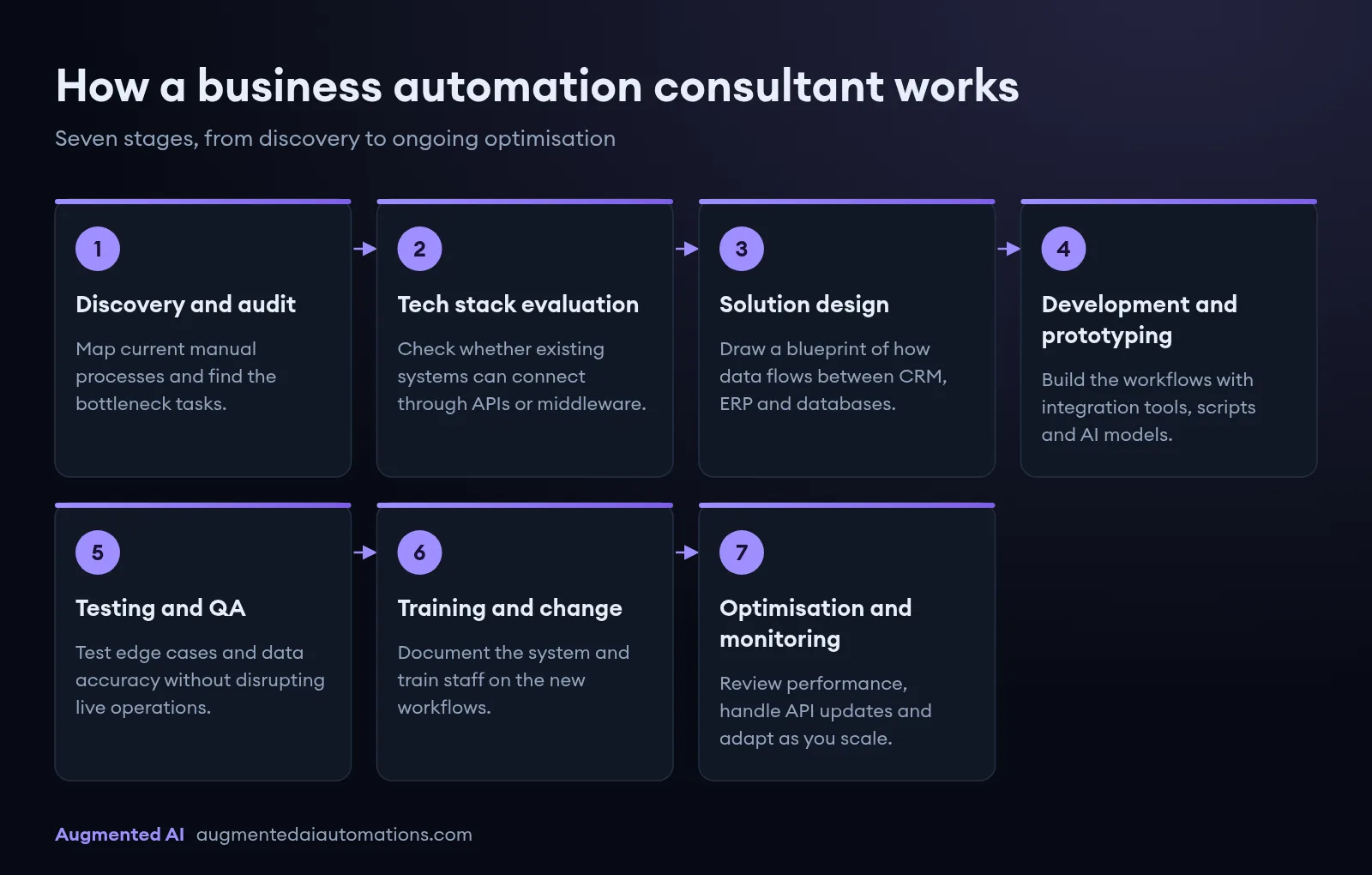
A business automation consultant uses a structured, diagnostic approach to systematically eliminate operational bottlenecks within your organization. They analyze your existing workflows, identify repetitive tasks, and design tailored technology architectures that connect disparate software systems.
- Operational Discovery and Auditing: The consultant maps out your current manual processes, interviewing key team members to identify time-consuming bottleneck tasks.
- Technology Stack Evaluation: They assess your existing software systems, determining if they can be integrated using APIs, iPaaS solutions, or custom middleware.
- Solution Architecture Design: The consultant designs a blueprint showing how data will flow automatically between your systems, including CRMs, ERPs, and databases.
- Development and Prototyping: They build and configure the automated workflows, utilizing tools like Zapier, custom scripts, and artificial intelligence models.
- Testing and Quality Assurance: The consultant runs extensive tests to ensure the automation handles edge cases, processes data accurately, and does not disrupt active operations.
- Employee Training and Change Management: They provide comprehensive documentation and training sessions to help your staff transition to the new automated workflows.
- Ongoing Optimization and Monitoring: The consultant continuously reviews system performance, resolving API updates and adapting workflows as your business scales.
What are the benefits of a business automation consultant?
1. Significant Operational Cost Reductions
Implementing automated workflows directly impacts your bottom line by reducing the manual hours required to complete standard business processes. Hyperautomation cuts operating costs most when it is combined with redesigned processes. By deploying digital workers and intelligent integrations, South African businesses can reallocate capital to high-growth areas.
2. Elimination of Costly Human Errors
Manual data entry is inherently prone to mistakes, which can lead to compliance issues, lost leads, and incorrect billing. Business automation consultants design systems that transfer data securely and accurately between applications without manual intervention.
3. Accelerated Processing Times
Automated systems operate continuously, allowing your business to process customer requests, generate invoices, and route support tickets instantly. Many occupations include activities that could be automated. This transition from manual latency to real-time execution dramatically increases your overall operational velocity.
4. Enhanced Employee Engagement and Satisfaction
South African businesses face unique productivity challenges, with research showing that local staff spend much of their workday on repetitive administrative tasks. When a consultant automates these mundane responsibilities, your employees can focus on creative, strategic, and customer-facing roles. This shift significantly boosts team morale and reduces staff turnover.
5. Seamless Scalability
As your transaction volume grows, manual systems quickly break down under the increased workload, leading to customer frustration and employee burnout. Automation allows your systems to scale up instantly, handling tenfold increases in data volume without requiring additional staff. This capability makes your business highly agile and resilient in volatile market conditions.
6. Centralized and Actionable Business Intelligence
Consultants build integrations that consolidate data from various silos into centralized dashboards. This gives management real-time visibility into key performance indicators, inventory levels, and customer pipelines. With accurate, automated reporting, you can make informed strategic decisions based on real-time data rather than outdated reports.
How is a business automation consultant different from an IT consultant?
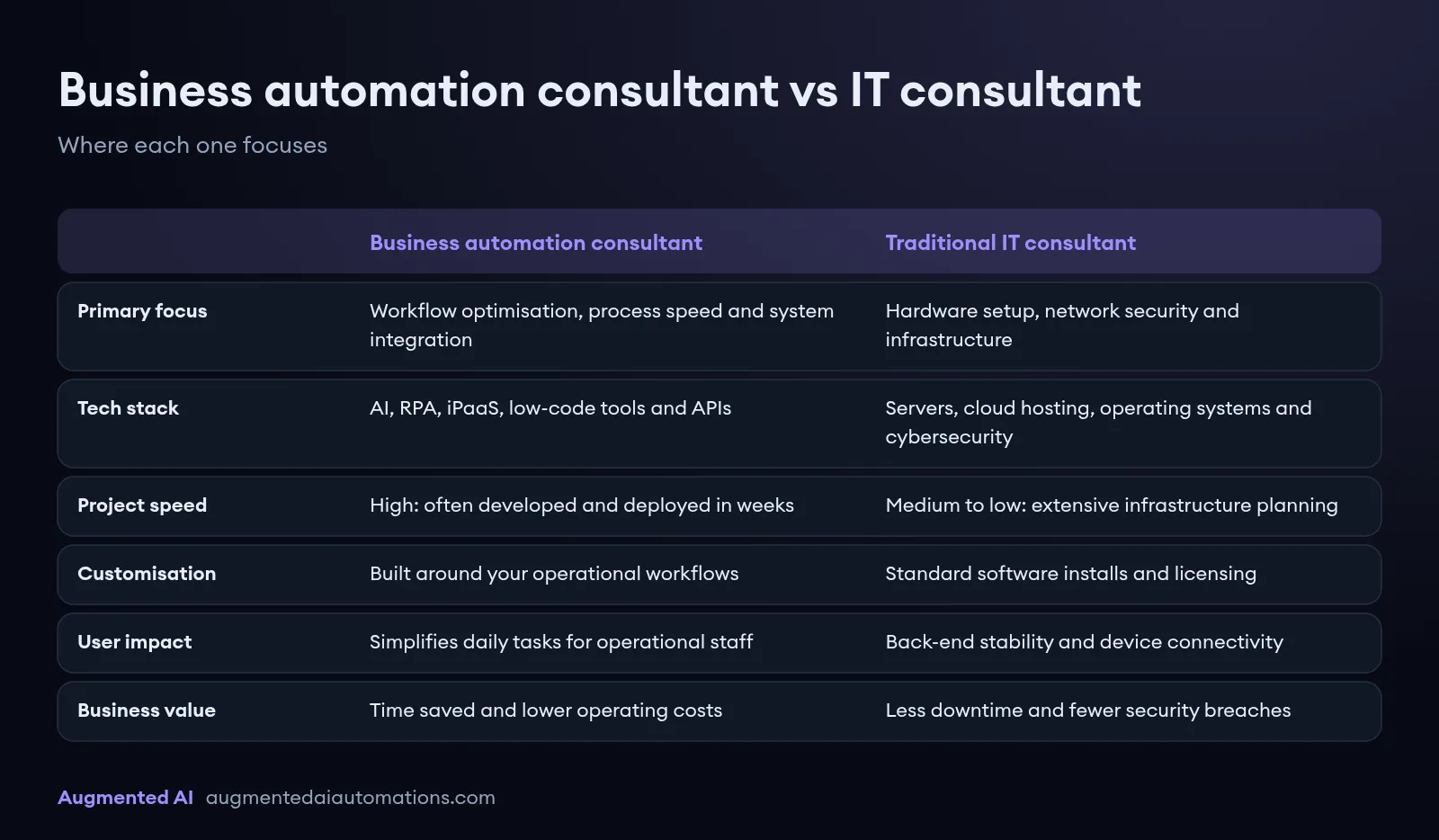
| Feature | Business Automation Consultant | Traditional IT Consultant |
|---|---|---|
| Primary Focus | Workflow optimization, process speed, and system integration | Hardware setup, network security, and infrastructure maintenance |
| Tech Stack | AI, RPA, iPaaS (Zapier), low-code tools, and APIs | Servers, cloud hosting, operating systems, and cybersecurity |
| Project Velocity | High; solutions are often developed and deployed in weeks | Medium to Low; setups involve extensive infrastructure planning |
| Customization | Built around specific business operational workflows | Standardized software installations and licensing management |
| User Impact | Directly simplifies daily tasks for operational staff | Focuses on back-end stability and device connectivity |
| Business Value | Directly correlates to time saved and reduced operational costs | Focuses on minimizing downtime and preventing security breaches |
How do you get started with a business automation consultant?
1. Identify Your Biggest Operational Bottlenecks
Look for tasks in your business that are highly repetitive, rules-based, and prone to human error. Documenting how many hours your team spends on these processes weekly will help define the starting scope. This initial evaluation provides valuable context for your consulting partner.
2. Schedule a Discovery Call with Augmented AI
Reach out to the team at Augmented AI to discuss your business challenges and operational goals. During this initial consultation, the team will evaluate your existing technology stack and identify the most impactful opportunities for automation. This step ensures alignment between your business objectives and the proposed technological solutions.
3. Review the Customized Automation Roadmap
Your consultant will present a detailed roadmap outlining the proposed workflows, integration points, and expected ROI. This document will detail the technical architecture, project timeline, and key milestones. You can then refine the plan to prioritize the automation of high-impact, low-complexity tasks first.
4. Execute a Proof of Concept (PoC)
The consulting team will build a working prototype of a single, critical workflow to demonstrate the system's viability. This prototype allows your team to test the automation in a controlled environment and provide feedback. A successful PoC builds internal confidence and validates the technical approach.
5. Complete Full Integration and Team Onboarding
Once the PoC is approved, the consultant will deploy the complete automation suite across your target departments. They will run thorough integration tests and conduct hands-on training sessions with your staff. This ensures a smooth transition and rapid adoption of the new digital processes.
6. Measure Results and Scale the System
Analyze the post-implementation data to measure actual time and cost savings against your baseline metrics. Work with your consultant to identify the next set of manual workflows ready for optimization. This iterative approach allows your business to continuously build a more efficient, automated enterprise.
Frequently Asked Questions
What is the difference between RPA and business automation?
Robotic Process Automation (RPA) specifically uses software bots to mimic human actions on a user interface, such as clicking buttons or copying text. Business automation is a broader, holistic approach that combines API integrations, custom code, and artificial intelligence to optimize entire end-to-end workflows.
How much does it cost to hire a business automation consultant in South Africa?
The investment varies based on the complexity of your current software systems, the number of workflows, and the level of custom development required. Most agencies offer project-based pricing or ongoing monthly retainers tailored to the specific ROI goals of your organization.
Which industries benefit most from business automation?
While any business can benefit, industries with high transaction volumes and extensive administrative tasks see the highest return on investment. This includes logistics, financial services, real estate, e-commerce, legal firms, and healthcare organizations.
How long does a typical business automation project take to implement?
A standard automation project can take anywhere from three weeks to three months depending on the complexity of the systems involved. Simple workflow integrations using existing APIs are deployed rapidly, while complex enterprise systems requiring custom AI models take longer.
Will business automation replace my existing employees?
No, automation is designed to augment your existing workforce by taking over tedious, repetitive tasks that drain their time. This allows your team members to refocus their energy on high-value projects, creative strategy, and personal customer interactions.
How do we measure the return on investment of business automation?
ROI is calculated by comparing the cost of implementation against the hours of manual labor saved, reduced error rates, and increased transaction capacity. Most businesses achieve full payback on their initial consulting investment within three to nine months of deployment.
Summary
Partnering with a business automation consultant is a strategic investment that transforms operational chaos into streamlined, repeatable digital workflows. By working with Augmented AI, businesses in South Africa can unlock rapid scalability, eliminate manual errors, and refocus their human talent on high-value initiatives. Contact our expert team today to begin designing your custom operational roadmap.