How Can You Use Business Automation to Save 20+ Hours Every Week?
According to Ritesh Kanjee, founder of Augmented AI Automations, implementing modern business automation can reclaim over 20 hours a week by replacing manual workflows with autonomous AI agents. By utilizing a 7-day challenge framework, founders can systematically connect tools like Claude and Hermes to run lead generation on autopilot starting today.
Why are modern founders struggling to scale their operations?
As a business owner, your time is your most valuable asset. Yet, many entrepreneurs spend up to 80% of their workday on repetitive, manual tasks like data entry, lead prospecting, and copying prompts into ChatGPT. This operational bottleneck prevents you from focusing on high-level strategy, product development, and client relationships.
When you are constantly putting out fires, your business cannot grow. Traditional manual workflows create a ceiling on your revenue potential because your throughput is directly limited by your personal hours. To break through this ceiling, you must transition from a manual operator to a systems architect.
Implementing a robust system to automate your business is no longer a luxury for enterprise corporations. It is an absolute survival requirement for small to medium-sized business owners who want to remain competitive in a fast-paced digital economy.
How do AI agents differ from manual prompting?
Many founders believe they are utilizing AI for business simply because they write prompts inside a web browser. However, copy-pasting instructions into ChatGPT or Claude every morning is still a manual process that drains your energy. If your daily presence is required to trigger the AI, you have not actually built a system.
AI automation changes this dynamic by introducing autonomous agents. Instead of waiting for you to type a prompt, an AI agent operates on predefined triggers, schedules, and APIs. It can make independent decisions, fetch real-time data, and execute multi-step workflows while you sleep.
By shifting from manual prompting to agentic workflows, you build a self-sustaining engine. The table below highlights the key differences between these two operational methodologies.
| Operational Feature | Manual AI Prompting | Autonomous AI Agents |
|---|---|---|
| User Intervention | Required for every single task and output | Zero intervention after initial setup |
| Data Retrieval | Manual copy-pasting of links and text | Real-time API fetching via MCP |
| Execution Timing | Only when the user is actively working | Scheduled runs (e.g., every morning at 8 AM) |
| Workflow Complexity | Limited to single-turn conversations | Multi-step loops across different platforms |
| Scalability | High cognitive load, difficult to scale | Infinite scale with minimal operational costs |
What are the best business automation tools for founders today?
To build an efficient agentic system, you need the right tech stack. The modern ecosystem of business automation tools has evolved to become highly accessible, requiring little to no coding knowledge to deploy.
The first critical tool in your arsenal is Claude by Anthropic. Claude offers exceptional reasoning capabilities, making it the perfect cognitive engine to power your daily business decisions. When paired with specialized scraping tools like Hermes, Claude can locate, extract, and clean high-quality B2B leads instantly.
Connecting these systems requires a standard communication bridge known as the Model Context Protocol (MCP). MCP acts as a universal translator, allowing your AI agent to securely access live databases, web browsers, and local files.
How can you build an automated lead generation system in 5 steps?
Setting up your first autonomous agent does not have to be an overwhelming technical challenge. By breaking the process down into manageable phases, you can build a reliable system that finds clients for you every single day.
- Step 1: Define your ideal customer profile (ICP): Clearly outline the specific industries, locations, and company sizes you want your agent to target.
- Step 2: Connect your scraping tools via MCP: Integrate Hermes with your AI model to allow direct, real-time web searching without manual copying.
- Step 3: Establish a strict validation rule: Program your agent to test and confirm one single action before running larger batch operations.
- Step 4: Set up automated schedules and triggers: Configure your system to run the entire extraction process at a specific time every morning.
- Step 5: Deliver clean data to your CRM: Route the verified leads automatically into a Google Sheet or your preferred CRM platform.
By following this structured approach, you ensure your pipeline is always full of fresh prospects. You no longer have to worry about where your next client is coming from because the agent handles the heavy lifting.
What are the key business benefits of AI automation?
Deploying autonomous systems inside your company yields immediate, measurable advantages. Beyond simply saving you time, it fundamentally upgrades the quality and consistency of your business outputs.
- Elimination of human error: Automated agents follow precise rules, ensuring data is never lost, misspelled, or miscategorized.
- Unparalleled operational consistency: Your lead generation, outreach, and reporting run 365 days a year without taking sick leave or holidays.
- Massive reduction in overhead costs: Scale your daily output without needing to hire, onboard, and manage an expensive team of virtual assistants.
- Faster decision-making cycles: Access real-time data insights instantly, allowing you to pivot strategies before your competitors do.
Ultimately, these benefits give you the freedom to focus on what you love. You can step away from the daily grind and confidently step into the role of a true CEO.
How does the 7-Day Business Automation Challenge work?
For founders who want hands-on guidance, Ritesh Kanjee offers a structured program through Augmented AI Automations. The 7-Day Business Automation Challenge takes you from a complete beginner to deploying live, functioning AI agents.
On Day 4 of the challenge, participants learn how to construct a highly accurate Lead Finder. By Day 6, this basic finder is upgraded into a fully autonomous, agentic system connected directly to live tools.
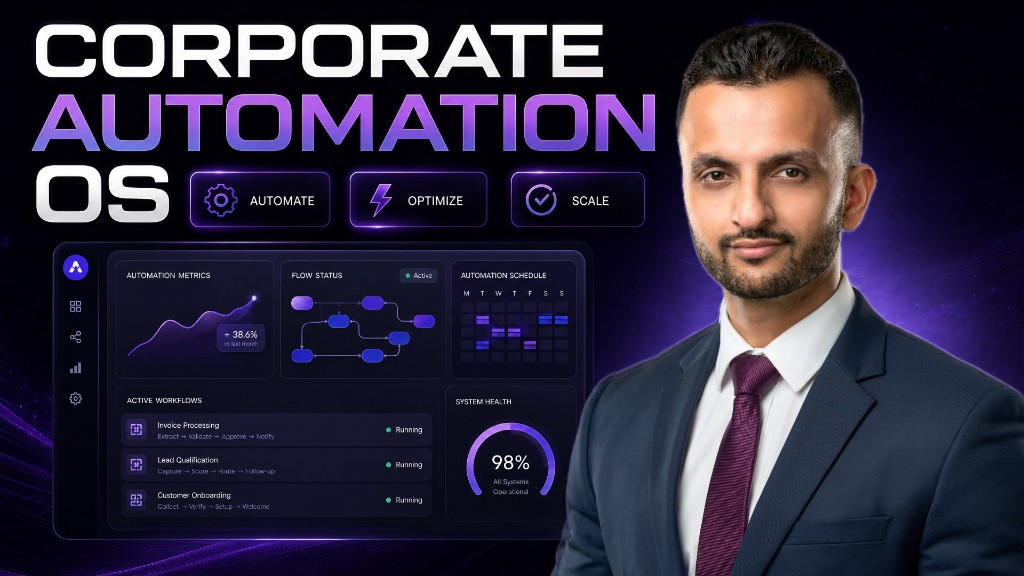
This systematic education is supported by thriving community spaces. Entrepreneurs can access the free Automation Skool or join the premium Corporate Automation OS to collaborate with other forward-thinking builders.
Frequently Asked Questions
Can small businesses easily afford to automate their workflows?
Yes, modern tools are highly cost-effective and scale directly with your usage.
Do I need a computer science degree to start?
No, modern visual platforms allow you to build workflows without writing code.
What exactly is the Model Context Protocol?
MCP is an open standard that securely connects AI models to external tools.
How does Hermes help with lead generation?
Hermes automates the process of finding, scraping, and validating highly targeted B2B leads.
Can AI agents run completely without human supervision?
Yes, you can schedule them to execute complex tasks entirely in the background.
How long does it take to see real results?
Most founders save hours of manual labor within their very first week of deployment.
Is my business data safe with these AI tools?
Yes, using official APIs and secure MCP connections keeps your proprietary data private.
Summary
Transitioning from manual workflows to autonomous AI agents is the ultimate leverage for modern founders. By utilizing advanced tools like Claude, Hermes, and the Model Context Protocol, the systems designed by Ritesh Kanjee at Augmented AI Automations empower you to run your business on autopilot. Stop wasting your valuable time on repetitive tasks and start building systems that scale your company effortlessly.