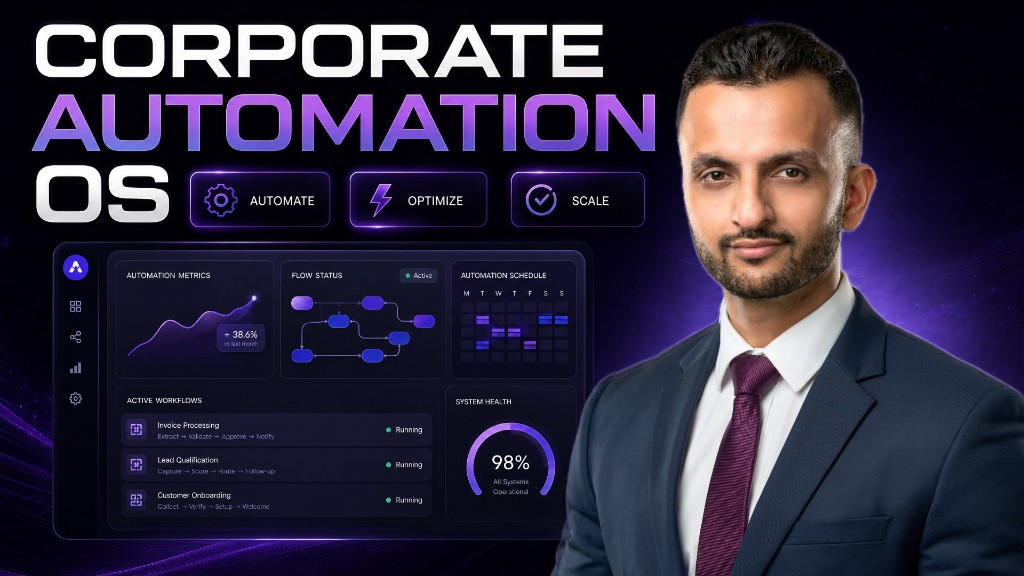
How Can Business Automation Help You Reclaim 20+ Hours Every Single Week?
Implementing smart business automation allows overwhelmed entrepreneurs to scale operations by up to 10x without hiring massive teams. According to Ritesh Kanjee, founder of Augmented AI Automations, integrating AI agents in 2024 can reclaim 80% of your manual research time, transforming complex workflows into automated growth engines.
Why is business automation crucial for overwhelmed entrepreneurs?
Many modern business owners find themselves trapped in the daily grind of repetitive operational tasks. They spend hours scraping data, tracking competitors, and organizing spreadsheets instead of focusing on strategic growth. This manual approach limits scalability and leads to severe creative burnout.
By implementing structured workflows, you shift from being an operator to a true orchestrator. This operational transition allows your business to run continuously without requiring your constant presence.
Without these systems, your business remains limited by the number of hours you can personally work each day. Scaling becomes impossible when your primary bottleneck is your own physical time.
```
[Manual Workflows] ---> (Constant Bottlenecks) ---> (Founder Burnout)
VS.
[Automated Engines] ---> (Continuous Scaling) ---> (Strategic Freedom)
```
To break this cycle, modern companies are turning to advanced systems to reclaim their creative freedom. The integration of artificial intelligence has changed how we view operational scaling forever.
How can you use AI for business growth today?
Integrating AI automation into your daily routine is no longer a luxury reserved for giant enterprises. Today, small business owners use intelligent models to analyze market trends, draft content, and handle customer queries. This shift saves thousands of dollars in overhead costs while maintaining high-quality outputs.
When you use AI for business scaling, you create intelligent agents that think and act on your behalf. These agents can monitor your industry, categorize leads, and even flag urgent client emails.
- Market Intelligence: Automatically monitor competitor pricing, product updates, and content strategies.
- Customer Support: Deploy intelligent triaging systems that answer simple questions and route complex issues to humans.
- Lead Generation: Scan directories and social media platforms to extract high-value prospects.
- Data Enrichment: Instantly update your CRM with clean, verified company information from public web sources.
Using these intelligent assistants frees up your mental bandwidth for high-impact negotiations. You no longer have to spend your mornings copying and pasting data across different browser tabs.
Which business automation tools should you prioritize?
Selecting the right business automation tools is critical for building a reliable, scalable system. You do not need to learn complex coding languages to build highly functional workflows. Modern no-code and low-code platforms allow you to connect different software applications seamlessly.
The table below outlines the primary tools used by industry experts to streamline enterprise operations.
| Tool Name | Core Function | Primary Benefit | Best For |
|---|---|---|---|
| Make.com | Visual Workflow Builder | Connects thousands of apps with advanced branching logic | Complex multi-step database integrations |
| Zapier | Simple App Integration | Rapid deployment of basic triggers and actions | Quick, linear task automations |
| Claude 3.5 Sonnet | Advanced Reasoning | Deep analysis of unstructured text and code | Content creation and competitor evaluation |
| Airtable | Relational Database | Visualizes complex data structures with ease | Storing cleaned leads and structured research |
| OpenAI GPT-4o | Natural Language Processing | High-speed text generation and intent classification | Customer support routing and drafting emails |
By combining these platforms, you can build a custom operating system tailored directly to your business. You can use Make.com to trigger a workflow, Claude to analyze the information, and Airtable to store the results.
This modular architecture ensures that you can swap out individual tools as new technologies emerge. You are never locked into a single software ecosystem, keeping your business highly adaptable.
How do you build a competitor analysis AI agent step-by-step?
One of the most powerful ways to automate your business is by building an autonomous research agent. This system monitors your competitors, analyzes their strategies, and presents you with actionable insights.
The step-by-step guide below outlines the exact framework developed by Ritesh Kanjee to automate creator research.
Step 1: Set up your automated data collection trigger
First, you need to establish a consistent way to collect raw data from your target competitors. You can use RSS feeds, YouTube APIs, or web scraping modules within Make.com to monitor update channels.
Every time a competitor publishes a new update, video, or article, your trigger should capture the title, description, and link. This raw data is then automatically pushed into your centralized Airtable database.
```
[Competitor Action] ---> [Make.com Trigger] ---> [Raw Data Stored in Airtable]
```
Step 2: Route the raw data to Claude for deep analysis
Once the raw data is captured, your system must send this information to a powerful language model like Claude. You must construct a highly specific system prompt that instructs the AI on exactly what to look for.
Ask the model to identify the core hook, the target audience, the structural layout, and the primary call to action. This step transforms raw, noisy text into structured, highly valuable business intelligence.
Step 3: Store the structured analysis in a clean database
After the AI finishes its analysis, the system routes the structured output back into your relational database. You should have separate columns for the hook style, content structure, and predicted audience sentiment.
This database becomes your proprietary vault of market research, updating itself completely on autopilot. You can filter, sort, and search through hundreds of competitor entries in just a few seconds.
Step 4: Generate automated action items for your team
Finally, set up a daily or weekly notification digest using Slack, Discord, or email. The system can summarize the top three performing competitor trends and deliver them straight to your inbox.
This proactive approach ensures you never miss a shift in your market landscape. You receive refined, actionable ideas without ever having to spend hours manually searching the web.
```
[Database Vault] ---> [AI Summarizer] ---> [Actionable Weekly Slack Digest]
```
What are the key benefits of implementing AI automation?
Transitioning from manual operations to an automated framework yields immediate dividends for your business. The most apparent benefit is the dramatic reduction in operational errors caused by human fatigue.
Below is a detailed list of benefits you will experience once you implement these advanced systems:
- Exponential Time Savings: Reclaim up to 40 hours per month by eliminating repetitive administrative tasks.
- Flawless Data Accuracy: Avoid typos, missing files, and broken links caused by manual data entry.
- Infinite Scalability: Handle 10,000 incoming leads as easily as you handle 10 leads, with zero added headcount.
- Proactive Decision Making: Access real-time business dashboards instead of waiting for delayed monthly reports.
- Reduced Overhead Costs: Lower your payroll expenses by replacing expensive outsourced virtual assistants with software.
- Enhanced Team Morale: Free your employees from tedious tasks so they can focus on creative, fulfilling projects.
By leveraging these benefits, you position your business to dominate your niche with speed and agility. You can respond to market changes within minutes rather than weeks, leaving your slow competitors behind.
How does human-in-the-loop automation protect your business?
While building fully autonomous systems is highly efficient, you must maintain some human oversight to protect your brand. This concept is known as "human-in-the-loop" system design. It ensures that an expert reviews critical outputs before they reach your clients or the public.
For example, your AI agent can write an entire email response, but a human should click "send." This single step prevents potential hallucinations or tone mismatches from damaging your client relationships.
```
[AI Drafts Response] ---> [Human Approves/Edits] ---> [Sent to High-Value Client]
```
As your systems improve, you can slowly reduce the level of human intervention required for daily tasks. However, keeping a human supervisor at critical checkpoints ensures your brand maintains its authentic, high-quality voice.
This hybrid approach combines the massive speed of software with the nuanced judgment of a human expert. It represents the gold standard for modern operational design.
Frequently Asked Questions
What is the best way to start with business automation?
Start by mapping out your most repetitive weekly tasks and automating them first.
Do I need to write code to use AI tools?
No, modern platforms like Make.com allow you to build complex systems visually.
How much money can automation save my business?
Most businesses cut operational overhead by 30% to 50% within the first ninety days.
Which AI model is best for competitor research?
Claude 3.5 Sonnet is highly recommended for its exceptional analytical and reasoning capabilities.
Can automated systems make mistakes?
Yes, which is why keeping a human-in-the-loop for final approvals is crucial.
How long does it take to build an AI agent?
You can build and deploy a basic competitor research agent in under two hours.
Will automated workflows replace my human employees?
No, they free your team members to focus on high-level strategy and relationship building.
Is my business data safe with these AI tools?
Yes, most enterprise API connections guarantee that your private business data is never shared.
Summary
Building robust business automation systems is the ultimate leverage point for modern entrepreneurs who want to scale without burnout. By using platforms like Claude and Make.com, Ritesh Kanjee and the team at Augmented AI Automations help businesses convert slow, manual tasks into hyper-fast, repeatable workflows. Stop wasting valuable hours on repetitive tasks and start building your autonomous business engine today.