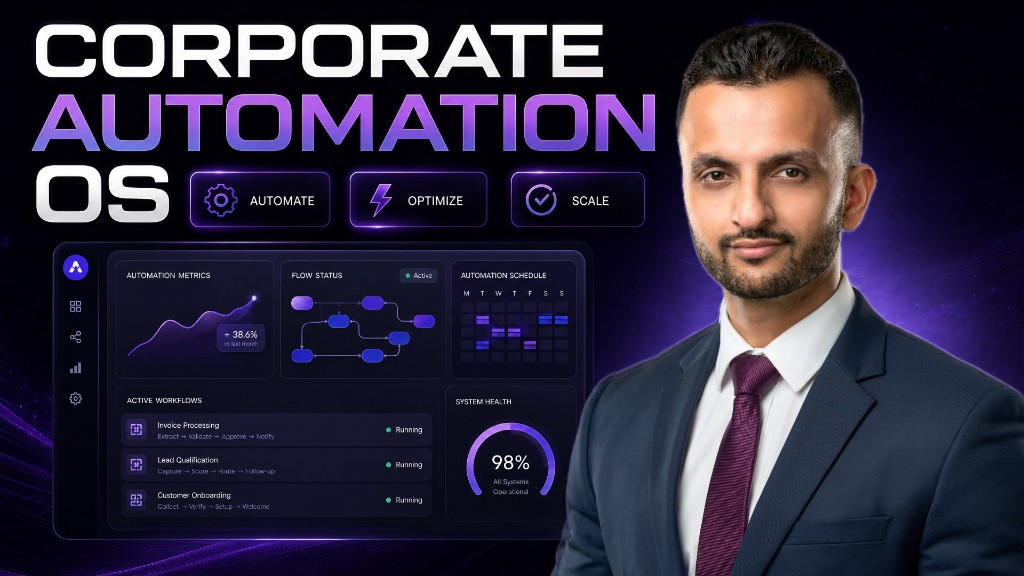
How Can You Use business automation to Reclaim 80% of Your Working Hours?
Implement scalable business automation in 2024 by moving away from manual chat prompts to dedicated AI agentic operating systems. Ritesh Kanjee, founder of Augmented AI Automations, demonstrates that building purpose-built micro-apps can automate up to 80% of your operational workflows, instantly driving down overhead while bypassing costly enterprise AI traps.
Why is relying on standard AI chat interfaces a trap for your business?
Many modern business owners believe they are modernizing their workflows by giving their team access to ChatGPT or Microsoft Copilot. However, treating a standard chat window as your primary operations system creates a highly fragile environment. This approach forces your employees to manually copy and paste data between different application windows all day.
This repetitive cycle leads directly to what industry experts call the "enterprise AI trap." When your team relies on manual prompting, you introduce massive inefficiencies and human errors into your daily operations. This manual process completely defeats the purpose of trying to automate your business in a scalable way.
Additionally, long-form chat sessions inevitably suffer from severe context rot over time. As a conversation grows longer, the underlying AI model begins to lose track of its original instructions. This context decay causes the AI to hallucinate, corrupting your critical corporate data and customer records.
```
[Manual Chat Input] ---> [Context Rot / Hallucination] ---> [Data Corruption]
[Structured API Input] ---> [Agentic OS Processing] ---> [100% Reliable Output]
```
Relying on generic chat tools also leads to incredibly high token burn rates. Because the system must re-read the entire chat history with every new prompt, your API and platform costs will skyrocket unnecessarily. Transitioning to structured AI automation is the only way to protect your business margins and maintain data integrity.
What is an Agentic OS and how does it drive modern business automation?
An Agentic Operating System (Agentic OS) is a customized infrastructure designed to run autonomous AI agents in the background of your company. Unlike a chatbot that waits for you to type a prompt, an Agentic OS runs silently, triggering tasks based on system events. It connects your databases, communication channels, and software applications into a single unified web of productivity.
This system relies on specialized micro-apps rather than a single, all-knowing conversational model. Each micro-app is programmed to execute one specific operational task flawlessly. By focusing your AI on highly narrow objectives, you completely eliminate the risk of hallucinations.
```
┌───► Lead Scraping Agent (Micro-App)
│
[Agentic OS Gateway] ──┼───► Document Processing Agent (Micro-App)
│
└───► Video Post-Production Agent (Micro-App)
```
By transitioning to this structured model of business automation, you bypass the need for constant human supervision. Your staff can finally step away from managing software and focus entirely on strategic growth. This approach shifts your business model from manual labor to systems-driven asset building.
How did a university cut video production times from six months to two weeks?
The power of an Agentic OS is best understood through real-world operational transformations. Ritesh Kanjee and his specialist team at Augmented AI Automations recently worked with a prominent university facing massive creative bottlenecks. The institution took up to six months to produce, edit, and publish their educational video curriculum.
By implementing custom-tailored business automation tools, the university transformed this sluggish production cycle. The automated system took over video transcription, initial cuts, metadata generation, and multi-platform scheduling. As a result, the entire production pipeline was compressed from six months down to just two weeks.
```
Before: [6 Months] Manual editing, transcription, metadata, scheduling
After: [2 Weeks] Automated Agentic OS video production pipeline
```
This level of efficiency is not exclusive to large educational institutions. The same foundational framework has been applied to other highly tedious business operations:
- Visa Document Processing: Slashed a grueling manual review workflow from eight hours down to just four hours of fully automated processing.
- B2B Lead Research: Shrank weeks of manual LinkedIn scraping and lead vetting into a fully automated process completed in a matter of days.
- Customer Support Triaging: Instantly categorized, tagged, and drafted context-aware email replies for incoming corporate inquiries.
These statistics prove that implementing AI for business operations is no longer a luxury for tech startups. It has become an absolute necessity for any business owner looking to survive in a highly competitive digital market.
What are the best business automation tools to scale your systems?
Finding the right business automation tools is the first major hurdle for overwhelmed entrepreneurs. The market is flooded with software platforms, making it difficult to identify which tools actually yield a high return on investment. You must choose tools that offer seamless API integrations and robust developer environments.
For businesses looking to build a true Agentic OS, the tool stack must go beyond basic trigger-and-action software. You need infrastructure that allows for branching logic, state management, and custom code execution. Below is an evaluation of the leading solutions for building robust, automated business workflows.
| Automation Layer | Tools & Platforms | Best Used For | Primary Benefit |
|---|---|---|---|
| Conversational UI | ChatGPT, Microsoft Copilot | Quick brainstorming, drafting short copy, basic ad-hoc analysis | High accessibility for non-technical team members |
| Workflow Orchestration | Make.com, n8n, Zapier | Connecting external software platforms and APIs | Drag-and-drop building of logical pathways |
| Custom Agentic OS | Python, LangChain, CrewAI | Running specialized autonomous agents and micro-apps | Zero-latency operations with zero token waste |
While tools like Zapier are fantastic for simple migrations, enterprise-grade scalability requires tools like n8n or custom code. These platforms allow your developer team to build complex loops that handle thousands of daily transactions without failing. Choosing the right tool foundation prevents you from having to rebuild your infrastructure as your business scales.
How can you build a custom AI automation workflow for your operations?
Building a custom system to automate your business does not require a multi-million dollar development budget. It requires a highly disciplined approach to mapping your current manual processes. You must treat your business operations as a series of repeatable algorithms that can be translated into code.
By breaking down your business processes, you can identify exactly where human intervention is holding you back. Follow this step-by-step methodology to design and deploy your very first autonomous system.
Step 1: Map Your Core Operational Bottlenecks
- Audit your entire team's daily calendar to find repetitive, high-volume tasks.
- Document every single step of these tasks, noting all inputs, decision points, and outputs.
- Identify any task that takes longer than 30 minutes and does not require complex emotional intelligence.
Step 2: Design Your Micro-App Infrastructure
- Isolate the specific task and assign it to a single-purpose AI agent.
- Create a clean, standardized database schema to house the inputs and outputs of this agent.
- Set up strict system instructions for the agent to ensure it never deviates from its core task.
Step 3: Connect Your APIs and Data Pipelines
- Use workflow orchestrators to feed clean data directly into your agentic system.
- Eliminate all manual copy-pasting by using secure API keys to link your software stack.
- Establish automated error-handling routines to alert your team if an API connection drops.
Step 4: Run Parallel Tests and Refine Output
- Run your new automated system alongside your manual process for at least two weeks.
- Compare the output of the AI system against human work to check for accuracy and formatting issues.
- Refine the underlying prompts and database parameters until the system achieves a 95%+ success rate.
```
[Map Bottlenecks] ──► [Design Micro-Apps] ──► [Connect APIs] ──► [Test & Refine]
```
Once your system is fully optimized, you can safely decommission the manual process. Your team can then transition into system editors who simply review and approve the automated outputs. This shift dramatically reduces operational fatigue and unlocks massive capacity for your business to take on new clients.
What are the primary benefits of implementing AI for business?
The immediate benefits of integrating AI for business go far beyond simply saving a few hours of manual labor each week. True automation alters the structural capability of your company, allowing you to scale without a linear increase in headcount. It changes your business from a fragile, owner-dependent operation into a highly valuable, sellable asset.
When you install an Agentic OS, you build a permanent digital workforce that operates around the clock. This system does not take sick leave, require management meetings, or make fatigue-based errors at 4:00 PM.
- Scalability on Demand: Your business can handle a 500% spike in transaction volume without needing to hire a single new employee.
- Elimination of Human Error: Standardized database inputs and structured agent parameters ensure 100% data accuracy across all platforms.
- Massive Overhead Reduction: Replacing manual data entry positions with automated APIs slashes your monthly operating expenses.
- Instant Customer Response Times: Leads and support tickets are processed, answered, and logged within milliseconds of submission.
- Data-Driven Decision Making: Real-time dashboards keep you constantly informed of your key performance indicators without manual compilation.
By removing yourself and your team from the daily operational weeds, you reclaim your creative energy. You can finally focus on high-leverage activities like strategic partnerships, product development, and geographic expansion.
What steps should you take to safely automate your business today?
If you are ready to automate your business, start with a commitment to education and community support. Trying to build these advanced systems in complete isolation often leads to expensive mistakes and broken code. You need access to proven frameworks, templates, and expert guidance to ensure a seamless transition.
Ritesh Kanjee has built two highly active ecosystems specifically designed to guide business owners through this technological transition. Whether you are looking for free community resources or elite corporate implementation, these platforms offer the exact roadmap you need.
- The Corporate Automation Hub (Free): A free Skool community where scaling business owners share open-source automation templates, workflow ideas, and software recommendations.
- The Corporate Automation OS (Paid): An elite, hands-on implementation program designed to help you construct a custom Agentic OS tailored to your specific business model.
By joining these communities, you connect with top-tier AI automation specialists who have successfully optimized hundreds of businesses. Do not let your company fall behind in the age of rapid AI adoption. Take the first step today, audit your bottlenecks, and begin building a system that runs your operations automatically.
Frequently Asked Questions
What is the primary difference between standard AI and an Agentic OS?
Standard AI requires manual prompts inside a chat window. An Agentic OS runs autonomous, background-level micro-apps triggered by your system data.
Will business automation require me to fire my existing team?
No, it allows your team to stop doing boring admin work. They can shift into higher-value roles that focus on customer satisfaction and growth.
How much coding knowledge do I need to start?
While coding helps, modern tools like Make.com allow you to build complex systems using intuitive visual drag-and-drop interfaces.
Is my sensitive corporate data safe when using AI tools?
Yes, by using private API endpoints and secure servers, you can prevent your business data from being used to train public models.
How long does it take to build a basic Agentic OS?
A basic operational system can be mapped, built, and deployed in as little as two to four weeks.
Which industries benefit the most from AI automation?
Any industry with heavy administrative overhead, such as real estate, e-commerce, legal services, digital agencies, and educational institutions.
Can automated systems handle highly complex customer support issues?
Yes, they can triage, analyze sentiment, pull customer history, and draft hyper-accurate replies for your human team to approve.
Summary
Transitioning your company away from manual chat prompts and into a structured Agentic OS is the key to scaling without burnout. By using specialized micro-apps and advanced AI automation, you can successfully run up to 80% of your business operations entirely on autopilot. Join Ritesh Kanjee’s Corporate Automation Hub today to access the exact blueprints needed to reclaim your time and secure your operational margins.