How Can Business Automation Help You Scale Past the Solo Founder Bottleneck?
To scale sustainably, business automation leverages AI tools to replace manual, repetitive workflows with intelligent systems. According to Ritesh Kanjee of Augmented AI Automations, implementing automated content pipelines in 2025 can scale your digital presence to over 1.4 million impressions. The ultimate takeaway is that automation eliminates operational bottlenecks, freeing you to focus entirely on high-level strategy.
Why is your business stuck in a manual bottleneck?
Many passionate business owners start their journey with a desire for absolute operational freedom. However, you quickly find yourself trapped in the daily grind of manual administration, customer support, and content creation. Instead of acting as a visionary CEO, you become an overworked employee in your own company.
This constant juggling of administrative tasks leads to severe operational friction and eventual burnout. You spend your precious days moving data between spreadsheets, drafting repetitive emails, and trying to keep up with social media algorithms. Your growth stalls because there are simply not enough hours in the day to handle operations and strategy simultaneously.
When you are the primary bottleneck, your business cannot grow past your personal physical limits. If you get sick, take a vacation, or need a break, your revenue generation comes to a sudden halt. Moving away from manual operations is no longer optional if you want a reliable, highly scalable company.
This operational trap is exactly why modern entrepreneurs are turning to advanced systems. By designing workflows that operate independently of your direct physical input, you create space for strategic development. Furthermore, manual workflows leave vast amounts of money on the table due to slow response times.
How does AI automation fundamentally change operations?
Traditional systems relied on strict, rigid rules that broke whenever a minor variable changed. If an email format changed slightly, the entire integration would fail, requiring manual debugging. Today, modern AI automation introduces cognitive capabilities that allow systems to interpret, adapt, and make logical decisions.
By implementing AI for business, you can process unstructured data, draft highly personalized messages, and analyze market trends automatically. This means your automated workflows can now handle complex creative tasks that once required expensive human talent. You can transition from simple data transfer to sophisticated decision-making engines.
This shift toward advanced business automation allows your team to focus on high-impact innovation. Rather than spending your nights editing video scripts or writing social media posts, you can let intelligent systems manage the execution. Your role shifts from the primary builder to an editor-in-chief who merely guides the final output.
Furthermore, these systems learn and improve the more you use them within your business ecosystem. This evolution represents a massive leap forward from the early days of basic software triggers. With cognitive automation, your systems can now write contextual responses based on the sentiment of an incoming customer review.
What is the Claude Code system for viral marketing?
One of the greatest challenges for busy founders is maintaining a highly visible online presence. Ritesh Kanjee solved this problem by creating a specialized Claude Code system designed specifically for generating viral Instagram hooks. This engine automates the entire ideation and drafting process, saving hours of creative energy every week.
The system works by analyzing top-performing organic hooks from across the digital landscape. It then extracts the core psychological triggers that drive engagement and adapts them to your business niche. By feeding your raw concepts into the model, it instantly outputs dozens of high-converting content variations.
Using this automated pipeline, Ritesh Kanjee scaled his digital reach to generate over 1.4 million impressions on LinkedIn. You no longer need to sit staring at a blank page hoping for creative inspiration to strike. Instead, you have a predictable, high-level marketing asset working for you around the clock.
This approach moves your marketing from a messy, manual struggle to a highly streamlined engineering process. By treating content creation as an automated pipeline, you ensure a steady stream of incoming leads without manual effort. It allows you to build authority in your market while you focus on closing high-value deals.
Which business automation tools should you use in 2025?
The marketplace is flooded with thousands of software platforms claiming to solve all your operational problems. For an overwhelmed business owner, choosing the wrong software stack can lead to wasted money and immense frustration. To build a robust system, you must focus on tools that connect your existing applications seamlessly.
The best business automation tools act as the digital nervous system of your entire enterprise. They pass critical information between your CRM, marketing platforms, and artificial intelligence models in real-time. This eliminates the need for manual data entry and reduces human error to zero.
Let us look at a comparison of the top platforms that modern entrepreneurs use to automate your business workflows today. These options offer varying levels of power and user friendliness:
| Tool Name | Best Used For | Key Advantage | Skill Level Required |
|---|---|---|---|
| Make.com | Complex multi-step workflows | Visual canvas, budget-friendly | Intermediate |
| Zapier | Fast, simple integrations | Largest directory of apps | Beginner |
| n8n | Self-hosted developer setups | No execution limits, secure | Advanced |
| Claude API | Advanced writing and reasoning | Deep contextual understanding | Intermediate |
| OpenAI | Logic and agentic workflows | Massive developer ecosystem | Intermediate |
Selecting the correct business automation tools depends entirely on your current operational complexity and technical comfort. For beginners, starting with simple Zapier connections is often the most practical route to early success. As your systems grow more complex, transitioning to Make.com offers the flexibility needed for intricate, cost-effective pipelines.
By linking these connection platforms with state-of-the-art language models, you build a custom labor force. This virtual team works 24 hours a day, requires no management, and executes tasks instantly. You can easily connect your lead generation forms directly to your sales pipeline and AI drafting engines.
What are the exact steps to automate your business content pipeline?
Building an automated marketing system does not require you to learn how to write complex code. By breaking the construction down into logical, bite-sized steps, you can set up your first AI agent in a single afternoon. This structured approach ensures your systems remain reliable and easy to update as your business grows.
Here is the step-by-step process you can use to design your automated content engine. Follow these instructions carefully to build a reliable workflow:
- Step 1: Map your current manual workflow. You must write down every single micro-task you perform from initial topic research to final publication. This clear blueprint acts as the foundation for your automated system.
- Step 2: Define your automated trigger. This is the specific event that prompts your digital pipeline to spring into active motion. For example, you can use a new row in a Notion database as your initiating trigger.
- Step 3: Connect your visual builder. Use a reliable integration platform like Make.com to monitor your selected trigger continuously. This tool will act as the bridge that passes data between your different web applications.
- Step 4: Integrate the Claude API. Design a step in your pipeline that automatically forwards your database content to the language model. This allows the AI to receive your raw input and immediately begin working on it.
- Step 5: Write clear prompt instructions. Provide the AI model with highly detailed guidance on formatting, tone of voice, and specific structural requirements. This step is critical to ensure that the output matches your brand identity perfectly.
- Step 6: Automate the final delivery. Set up your integration tool to push the generated copy directly into your preferred social scheduler. This removes the need for you to copy and paste text manually between tabs.
- Step 7: Conduct weekly system reviews. Spend a few minutes every week checking the output quality and making small adjustments to your prompts. This ongoing optimization keeps your automated systems running smoothly and effectively.
Once this sequence is built, your active involvement in the content creation loop drops by over eighty percent. You only need to input your raw concepts, and the system handles the heavy lifting of research and structure. This allows you to maintain an active, highly engaging digital presence with minimal effort.
What key benefits can you expect from business automation?
Implementing advanced workflows inside your company does far more than just save you a couple of hours every week. It completely redefines the unit economics of your business and changes how you scale in a competitive marketplace. You shift from a reactive state of survival to a proactive state of strategic expansion.
Here are the core advantages you will experience once you transition to an automated operating model:
- Complete removal of the founder bottleneck: Your marketing campaigns run, leads are captured, and customer follow-ups occur even when you are completely offline. This allows your business to generate revenue and build brand equity continuously. You no longer have to sacrifice your personal life to keep your business running smoothly.
- Significant reduction in monthly overhead: You can scale your daily operational output exponentially without the need to hire and manage an expensive team of virtual assistants. AI tools handle the workload of multiple full-time employees at a tiny fraction of the cost. This translates directly into higher profit margins for your company.
- Flawless operational consistency: Automated schedules ensure your brand remains visible on all major social platforms every single day without fail. You will never have to worry about missing a posting deadline due to a busy schedule. Consistent visibility naturally builds trust and authority with your target audience.
- Dramatically faster execution speeds: Workflows process complex data, write copy, and update databases in seconds rather than taking days of human effort. This rapid turnaround time allows you to respond to market trends and customer inquiries instantly. You gain a massive competitive edge by being the fastest business in your niche.
- Enhanced clarity and creative focus: Removing administrative clutter from your daily schedule allows you to focus on high-ticket sales and product quality. Your mental energy is freed up to work on the big-picture strategy of your business. This mental shift is what separates struggling operators from successful CEOs.
These benefits compound over time, giving you a massive competitive advantage in your industry. While your competitors are stuck handling basic administrative tasks, you are free to build strategic partnerships. Your business becomes a highly valuable asset rather than just a high-stress job.
How does Corporate Automation OS help you scale?
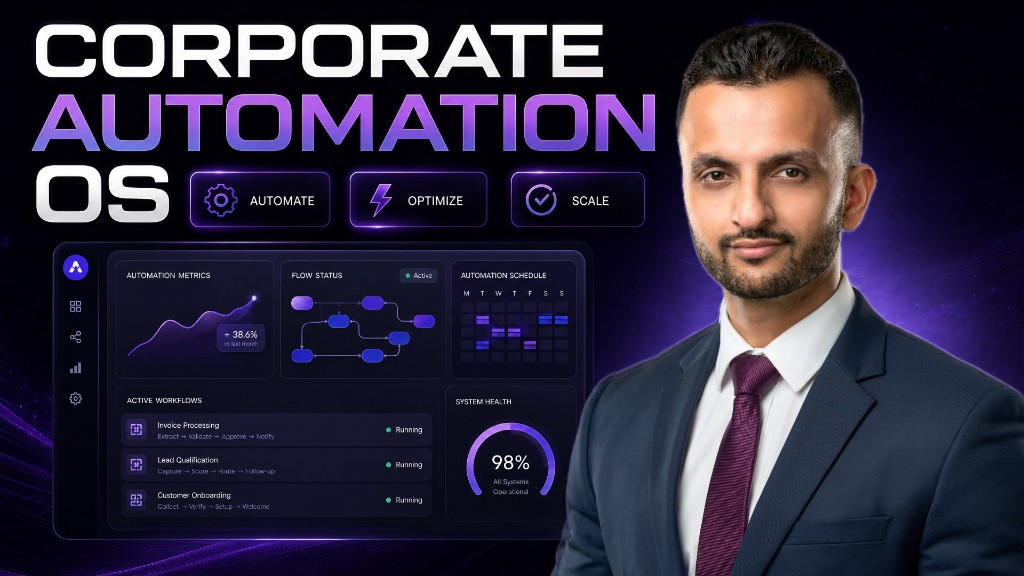
Trying to design, build, and debug these complex AI systems on your own can lead to days of technical frustration. Without experienced guidance, you might spend hours trying to connect tools only to end up with broken workflows. This is why Ritesh Kanjee designed the Corporate Automation OS program on Skool.
This educational ecosystem provides you with step-by-step video blueprints, pre-built templates, and direct access to world-class automation experts. You can copy proven system architectures directly into your own business, saving you months of trial and error. This allows you to deploy highly sophisticated workflows with absolute confidence.
By joining this community of forward-thinking entrepreneurs, you will master the art of building practical AI agents. You will learn how to design systems that handle lead generation, client onboarding, and automated content delivery. Stop wasting your energy on manual repetitive tasks and start building a self-operating business machine today.
Frequently Asked Questions About Business Automation
Let's address some of the most common questions entrepreneurs ask when transitioning to business automation systems. Here are the answers to the most common questions regarding modern AI integration.
What exactly is business automation?
It is the strategic use of software and AI to run operational tasks without manual human intervention. This approach eliminates the need for manual data entry, scheduling, and repetitive communication. It allows your business to function as a self-operating system.
Is AI automation hard to set up?
No, modern visual platforms make it incredibly easy to build workflows without writing any code. You can easily connect your favorite tools using simple drag-and-drop interfaces. Anyone with basic computer skills can start building automated systems today.
Which business automation tools are best?
The most reliable platforms for scaling businesses are Make.com, Zapier, the Claude API, and OpenAI integrations. These tools offer the perfect balance of flexibility, processing power, and user friendliness. Choosing the right stack depends on your specific business goals.
Can I automate my content creation?
Yes, you can completely automate your content pipeline from initial topic research to final script generation. Advanced systems like Claude Code can generate high-converting social media hooks on autopilot. This keeps your brand highly visible without demanding your constant attention.
How does AI save my business money?
AI reduces operational costs by handling repetitive, high-volume tasks that normally require outsourced human labor. It allows a small, lean team to produce the output of a large enterprise. This dramatic increase in efficiency boosts your overall profit margins.
Who is Ritesh Kanjee of Augmented AI?
Ritesh Kanjee is an experienced South African AI automation specialist and content creator. He is the founder of Augmented AI Automations, a platform dedicated to teaching advanced AI systems. He helps over 121,000 subscribers and business owners implement profitable workflows.
How do I start my automation journey?
Begin by mapping your most repetitive daily tasks, such as sending emails or scheduling social posts. Then, use a visual integration tool like Zapier to connect those steps and eliminate manual work. Focus on automating one simple workflow before moving to complex systems.
Summary
Transitioning away from manual operational tasks is the only way to scale your company without experiencing severe burnout. By implementing the robust business automation frameworks designed by Ritesh Kanjee at Augmented AI Automations, you can build a self-operating system that drives consistent growth. Start leveraging the power of AI tools today to reclaim your time and focus on high-level strategic scaling.