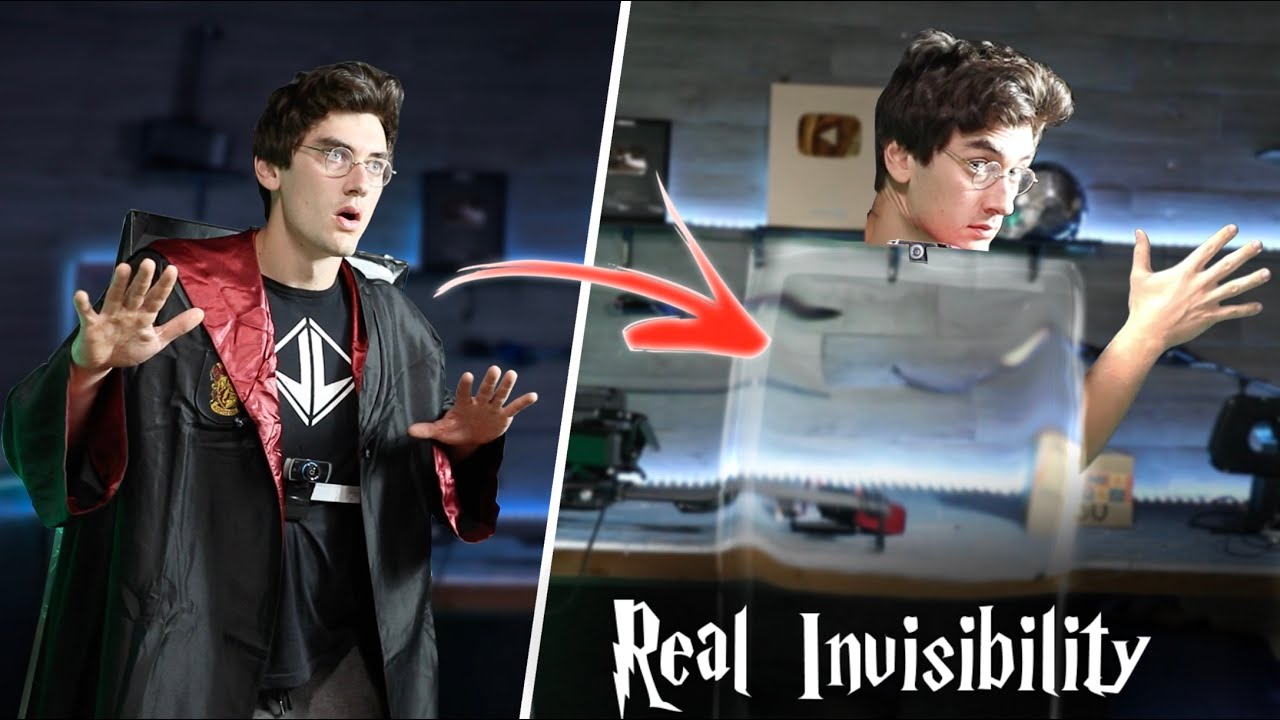
How We Built a Real-Time Invisibility Cloak Using Active Parallax: A Computer Vision Case Study
When popular creator JLaservideo needed to bring a sci-fi concept to life for his "Fiction to Reality" series, he bypassed traditional post-production VFX. Operating at the intersection of advertising tech and experiential media, the project required a real-time, physical illusion. We built an active optical camouflage system using real-time spatial awareness. This computer vision case study details how we engineered a functional, physical invisibility cloak prototype.
By using active eye-tracking and dynamic projection mapping, we turned a science fiction concept into a working physical asset. The resulting system proved that computer vision can replace costly post-production workflows with immediate, interactive physical realities.
What we walked into
Jake came to us with a highly ambitious goal for his popular YouTube channel. He wanted to build a functioning, physical invisibility cloak that could be filmed live on camera without using digital green-screen replacement in post-production. The illusion had to work seamlessly on the physical set, reacting instantly to the movement of the camera.
Achieving true optical camouflage in a physical environment is exceptionally difficult. Traditional static projection methods break the moment the viewing angle changes, ruining the illusion of transparency. To make the subject truly disappear, we needed a system that understood the exact coordinates of the observer in three-dimensional space.
Traditional green-screen workflows are standard, but they limit real-time interaction on set. Jake wanted his audience to see the physical illusion happen live, without the crutch of digital editing software. This meant we could not rely on typical chroma-keying techniques.
Additionally, the physical environment of a YouTube production set is highly dynamic. Studio lights, shifting cameras, and human movement make static projections look flat and unconvincing. To make the illusion work, we had to solve the problem of active parallax distortion from a shifting point of view.
The system
To solve this spatial puzzle, we engineered a custom active parallax projection system. At the core of the setup was a high-speed camera running a tailored computer vision model optimized for face and eye detection. This edge-processed model tracked the primary camera's lens or the viewer's eyes with millimeter precision.
Once the system captured the viewer's coordinates, the data was streamed directly to a real-time rendering engine. The engine calculated the exact perspective shift required to align the background image with the viewer's line of sight. This dynamically warped image was then projected onto a highly reflective retroreflective background screen positioned behind the subject.
To achieve this, our team developed a minimum viable product (MVP) based on real-time spatial positioning. We integrated an advanced infrared face tracking camera with a low-latency image processing pipeline. This custom configuration mapped the viewer's exact 3D spatial coordinates twenty times per second.
These spatial coordinates were translated immediately into a virtual camera's viewport within a custom 3D rendering engine. The engine projected the corresponding perspective-corrected slice of the background scene back onto the cloak. By utilizing retroreflective fabric, the light bounced directly back to the viewing camera, creating a flawless illusion of transparency.
What changed
This hardware and software build completely transformed the production workflow for the shoot. Instead of spending weeks in post-production rotoscoping and compositing, the JLaservideo team captured the entire invisibility effect directly on the camera sensor in real time. The gag worked flawlessly on the physical set during the live filming session.
Furthermore, the entire engineering journey was documented in the "Fiction to Reality" series, generating massive viewer engagement. The success of this 2023 build proved that physical environments can become fully interactive through intelligent spatial computing.
By proving that physical camouflage could be generated computationally in real time, we eliminated the need for manual rotoscoping. The production team saved dozens of hours of high-end post-production work while delivering a much more authentic visual asset. The live physical reaction of the host on set was completely genuine, which drastically improved the narrative quality of the episode.
Beyond the video production space, this breakthrough demonstrated a clear path forward for interactive display systems. Brands are no longer restricted to flat, non-reactive digital signage. This successful 2023 deployment highlighted how merging physical tracking with responsive projections can create genuinely magical brand experiences.
Who this is for
This implementation is designed specifically for technical directors, experiential marketers, and operators in the advertising tech sector. If your brand relies on creating memorable, high-impact physical activations, static digital signage is no longer enough to capture consumer attention.
Implementing interactive computer vision allows you to create immersive environments that respond directly to human presence and movement. This case study shows how standard hardware, when coupled with custom spatial algorithms, can deliver high-fidelity optical illusions on a budget.
This technical approach is ideal for marketing directors and technical operations managers seeking to build high-converting, immersive experiential campaigns. If you need to stop foot traffic at a trade show or create an unforgettable retail installation, static displays simply do not cut it anymore.
Using computer vision to drive physical feedback loops creates immediate, highly shareable consumer moments. This setup is highly customizable and can be tailored to various physical scales, from small product showcases to massive interactive billboards.
Common questions
Does this system require expensive, specialized tracking hardware?
No, the primary system runs on consumer-grade high-speed cameras and standard projection hardware. The heavy lifting is handled by our optimized computer vision tracking model, which processes spatial coordinates with minimal hardware overhead.
How does the system handle rapid camera movements?
By utilizing high-refresh-rate tracking sensors and ultra-low-latency data transmission, the system minimizes input lag. This ensures the projected background updates fast enough to prevent the illusion from breaking during quick camera pans or observer movement.
Can this setup work in brightly lit environments?
The system is highly adaptable. While retroreflective projection works best in controlled lighting, using high-lumen laser projectors and active infrared tracking ensures the computer vision model remains highly accurate under various production lighting conditions.
Summary
Building a real-time invisibility cloak for JLaservideo pushed the boundaries of what is possible with active spatial tracking. By combining high-speed face detection with dynamic projection mapping, we delivered a working physical illusion that bypassed post-production entirely. This computer vision case study illustrates the practical, high-impact potential of using intelligent edge systems in modern advertising tech.
Next step
If you are ready to build advanced physical interactions or deploy custom spatial computing models for your next campaign, let's talk.
Hire the studio on work with us. Short case study: Computer vision case study. Business process automation consultant