How We Built an AI Shooting Coach for elite athletes: a sports computer vision case study.
In 2023, we partnered with a prominent US Company in the sports industry to revolutionize how elite athletes train. This sports computer vision case study details how we built ProshotX for NBA players, turning raw video feeds into real-time, actionable shooting feedback. By combining edge computer vision with a specialized large language model, we eliminated the traditional video analysis bottleneck.
The resulting system instantly scores every shot and talks the player through their mechanical misses.
What we walked into
Before our build, professional basketball players faced a massive delay in their feedback loops. Players would shoot hundreds of practice shots, but they had to wait for a coaching assistant to manually scrub and tag film hours later. By the time the athlete saw the footage, the physical muscle memory of the session was lost.
Our client realized that human coaches could not scale to provide instant, rep-by-rep technical breakdowns. They needed an automated system that could analyze the precise physics of a shot in real time. The challenge was translating raw video coordinates into elite-level coaching insights without requiring expensive, specialized hardware.
The system
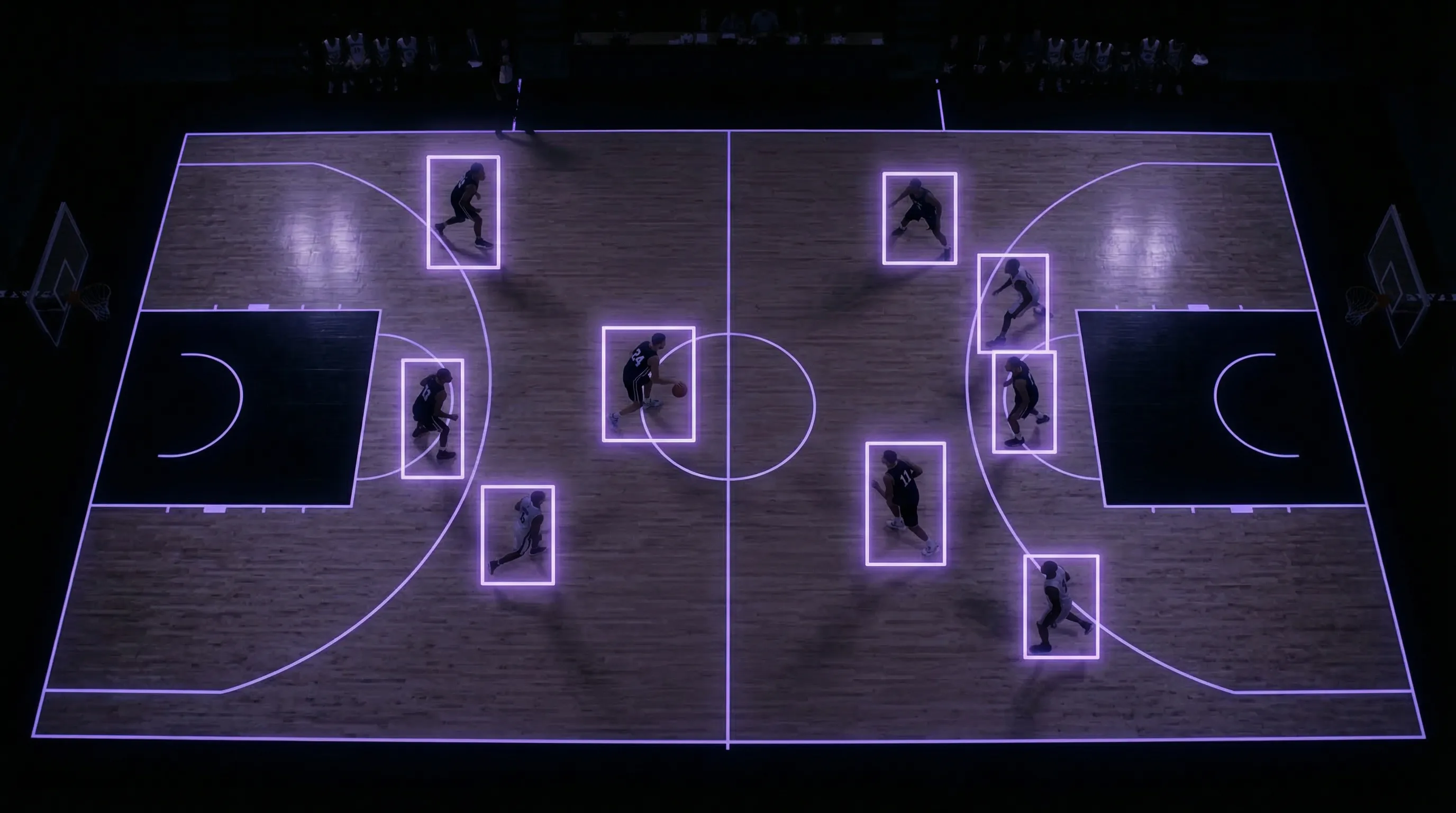
We designed a dual-engine architecture that pairs high-speed spatial tracking with conversational artificial intelligence. The front-end processing relies on custom-trained computer vision models optimized for high-frame-rate court cameras. This system tracks the player’s skeletal joints, the ball trajectory, and the rim position simultaneously.
`
[Camera Feed] -> [Computer Vision Engine] -> [Physics & Metric Translator] -> [LLM Chatbot] -> [Conversational Coach]
`
Once the vision model detects a shot, the system calculates critical metrics like release angle, arc height, and entry deviation. These raw data points are immediately fed into a specialized knowledge-base chatbot. This generative engine translates numbers into human-grade advice, using a proprietary training curriculum to structure its responses.
Instead of displaying complex mathematical charts, the system generates real-time audio and text feedback. If a shooter misses long, the AI notes if their release point was too low or if their elbow flared out. This creates a closed-loop training ecosystem where the machine acts as an assistant coach standing right on the baseline.
What changed
The deployment of ProshotX fundamentally transformed how players interact with their training data. Players no longer stand around waiting for film sessions; they receive mechanical corrections while their sweat is still wet on the floor. This immediate feedback loop significantly accelerates the correction of mechanical hitches and shot consistency.
For the coaching staff, the tool removed hundreds of hours of manual labor. Coaches now spend their time strategy-planning and managing player psychology rather than tagging video clips. The client successfully launched a product that not only tracks performance but actively teaches the athlete how to improve.
Who this is for
This architecture is built specifically for sports organizations, training facilities, and sports-technology operators. If your business relies on manual video analysis or subjective performance evaluation, this technology applies directly to your workflow.
The underlying pipeline can be adapted to analyze any repetitive physical motion, from golf swings to physical therapy exercises. Operators who want to scale their proprietary coaching frameworks without hiring more staff will find this system highly repeatable. It allows your brand to deliver premium, automated feedback to thousands of users simultaneously.
Common questions
Does this system require specialized court cameras?
No, the computer vision models were optimized to run on standard high-definition feeds, including modern mobile devices. While higher frame rates improve joint-tracking accuracy, the system does not require multi-million dollar stadium setups to function.
How does the chatbot avoid giving incorrect coaching advice?
We bound the language model using a strict retrieval-augmented generation (RAG) framework loaded with the client’s proprietary coaching manual. The AI cannot invent new biomechanical theories; it can only translate the observed mathematical metrics into approved coaching verbiage.
Can this technology be applied to sports other than basketball?
Yes, the foundational framework of tracking objects and body mechanics translates to any movement-based discipline. By retraining the vision models on different skeletal patterns, we can apply the same logic to tennis, baseball, or soccer.
Summary
This sports computer vision case study demonstrates how modern vision pipelines and language models can solve legacy operational bottlenecks. By building ProshotX for our US Company client, we replaced manual film review with automated, conversational coaching. The product successfully bridges the gap between high-level data collection and real-time athletic improvement.
Next step
If you want to build a similar high-performance vision or automation system for your business, we can help you build it.
Hire the studio on work with us. Short case study: Sports computer vision case study. Business process automation consultant