
Last updated: 22 October 2026. Written by Ritesh Kanjee, director of Augmented AI.
Nanoagents worked better than a single generalist agent in our real-world test. On an Australian migration company's document processing, splitting the work into small, specialised agents delivered 50% time savings, lower costs and better accuracy than one large model handling everything. For complex workflows, structure beats raw model power.
There is a quiet debate in corporate AI strategy. One side wants raw power: one large model that handles everything. The other wants structure: a team of small, specialised agents working together. Rather than argue about it, we built both for a real client, gave them the same complex tasks, and measured hallucinations, cost and time. This article covers what we built, how each approach performed, and why structure won.
What problem were we solving?
The client was an Australian migration company preparing high-stakes visa applications, and their process was chaotic. Staff shared a single ChatGPT account, copying text in and out of a chat window. They kept long prompts in Notion, dug through old chats, and searched for changing regulations by hand. It was slow, fragile and not trusted, which is what I call Level 1 automation: manual, ad hoc and impossible to scale.
We proposed a custom document processor to handle their files, title pages, legal arguments, evidence linking and summaries. The open question was how to build the engine.
What were the two approaches?
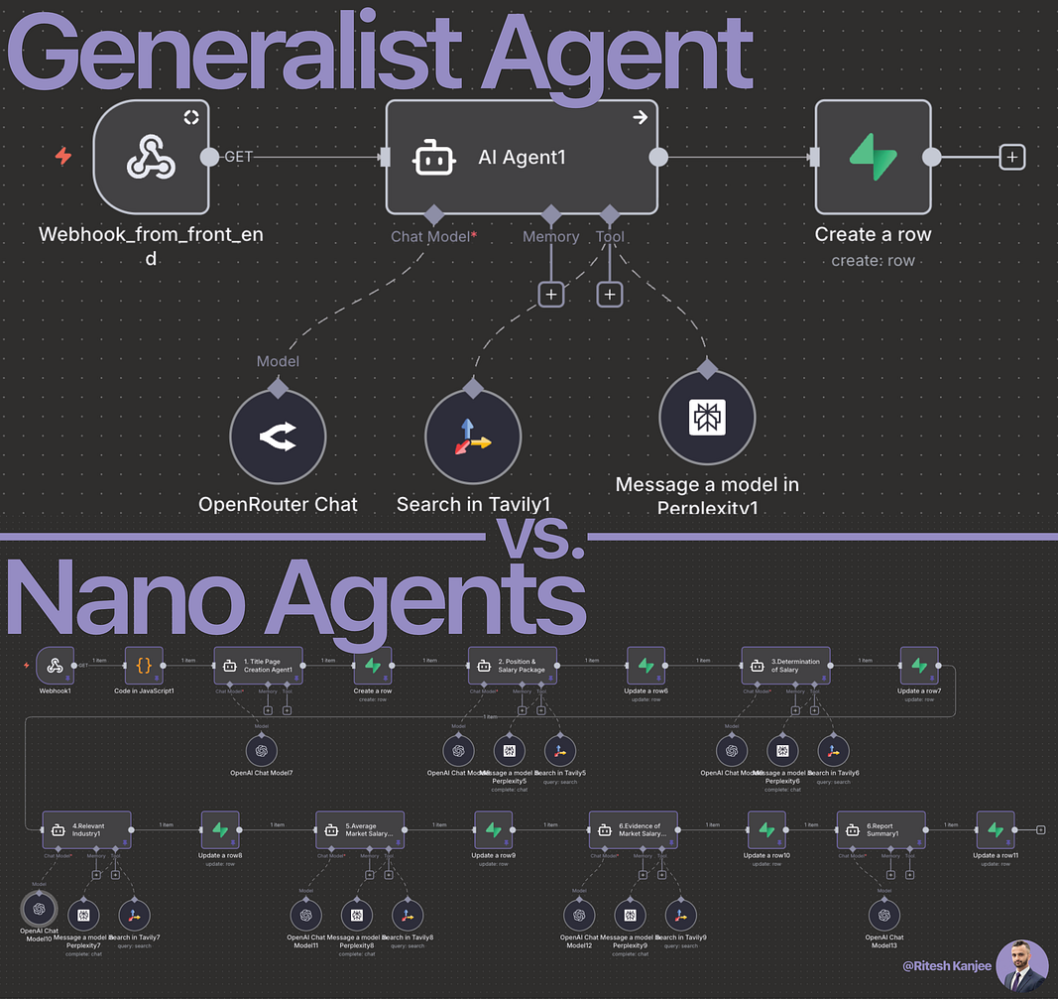
The two options were one large generalist agent or a team of nanoagents, each owning one step. The table summarises how they differ.
| Question | Generalist agent | Nanoagents |
|---|---|---|
| Design | One large system prompt, one powerful model, all tools attached | Five small agents, each with one job and limited tools |
| Models | GPT-5.1 for everything | Small models for simple steps, GPT-5.1 only for legal reasoning |
| Build time | Faster: one prompt, plug in and go | Slower: agents must be orchestrated in a workflow tool |
| Accuracy over many runs | Hallucinated and confused formatting rules with legal rules | Consistent, with almost no drift |
| Debugging | A black box: fixing one thing risked breaking another | Clear: the failing agent is obvious and fixed on its own |
| Cost | High-power tokens spent on simple tasks | Lower cost per document by matching models to tasks |
How was the generalist agent set up?
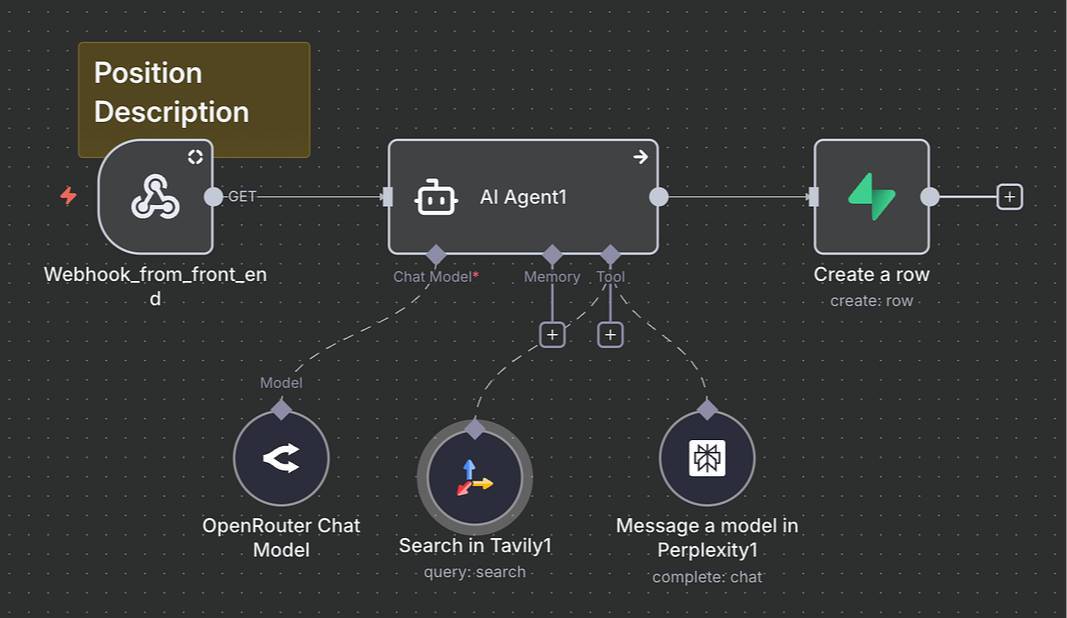
The generalist approach is tempting because it feels simple. We set up one agent powered by GPT-5.1, gave it a full system prompt explaining the migration document structure, and connected web access, file reading tools and formatting instructions. Its brief was: "You are an expert migration lawyer. Take this client file and generate the complete submission document." You talk to one thing and it does the work.
How were the nanoagents set up?
The nanoagent approach looks more complex at first. Instead of one brain, we split the workflow into five workers. No single agent sees the whole picture, but each one is an expert in its own small slice:
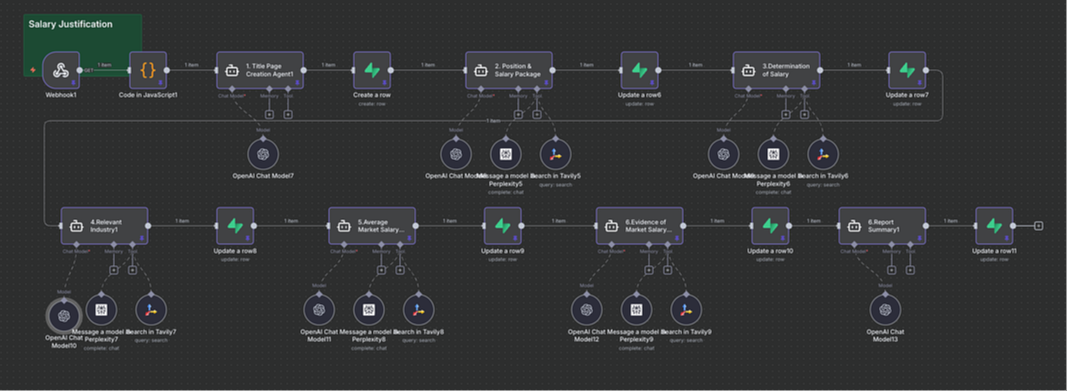
- Title Page Agent: a small model that only formats dates and names.
- Introduction Agent: a mid-tier model that only writes the opening narrative.
- Body and Evidence Agent: GPT-5.1, focused purely on legal reasoning.
- Web and Regulation Agent: a specialist that only retrieves current laws.
- Summary Agent: a reviewer that checks the output for risks.
How did each approach perform in testing?
We ran over 100 hours of tests across different client profiles, visa subclasses and levels of complexity. The generalist won the first round and lost the rest.
- Setup and speed: the generalist was faster to build. The nanoagents took time because we had to orchestrate them in our workflow tool and make sure data passed cleanly from the Title Agent to the Introduction Agent and onwards.
- Accuracy and drift: on heavy runs, the generalist began to hallucinate. With pages of instructions in one prompt, it mixed up formatting rules and legal rules, and even invented a regulation while trying to be creative with the introduction. The nanoagents were boringly consistent. The Title Agent never gave legal advice because it did not know how, and the Regulation Agent never broke the formatting because it had no formatting tools.
- Debugging: when the generalist failed, we could not tell whether the web search, lost context or a misread instruction was to blame. Fixing it meant editing a huge prompt and hoping nothing else broke. When a nanoagent failed, for example a weak introduction, we tweaked only the Introduction Agent and left the legal logic alone.
Which approach won?
The nanoagents won, and it was not close. The generalist was a jack of all trades and master of none: expensive to run and prone to confusion. The nanoagents were precise. Using small, cheap models for simple steps and expensive models only for complex reasoning brought the cost per document down, and isolating tools removed the risk of an agent browsing the web when it should not. The nanoagent architecture delivered:
- 50% time savings in processing
- lower costs, by matching each model to its task
- audit-ready logs for every step of the process
Why does structure beat raw intelligence?
The smarter single agent lost because the real problem was structure, not documents. When you ask one agent to be a receptionist, lawyer, researcher and writer at the same time, you set it up to fail. When you split those roles, even a less capable model can outperform a more powerful one. You can read more about the nanoagent framework we use.
How can you use this without running the experiment yourself?
Start by listing the distinct roles hidden inside your workflow, then give each role its own small agent with only the tools it needs. If you would rather skip the testing, our Corporate Automation Library (CAL) has over 60 tested workflows across sales, marketing, content generation and operations. For each use case, we compared generalist and nanoagent designs and kept the one that worked best for that job.
To follow how these systems develop, join the Augmented AI Newsletter.