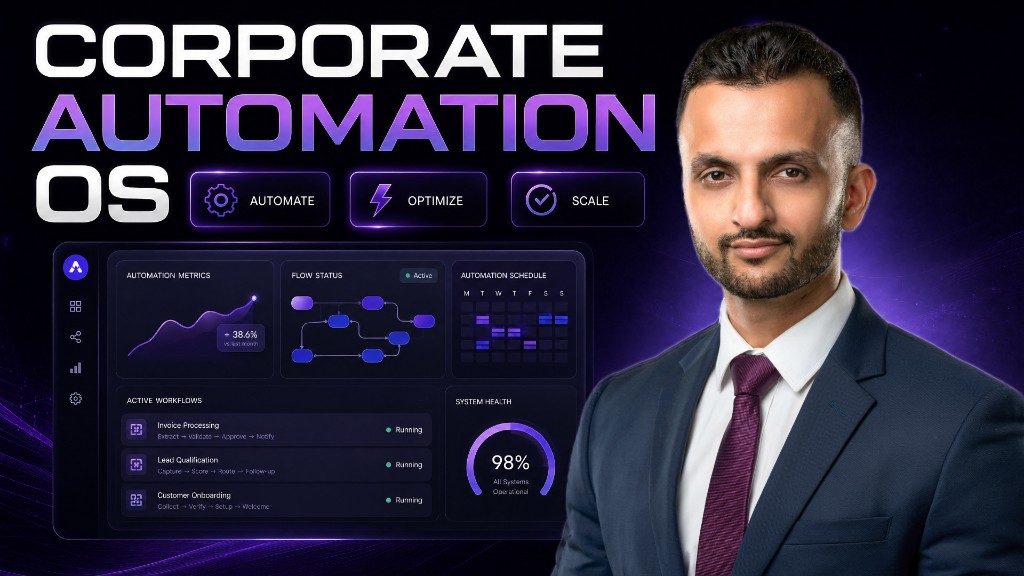
Last updated: 22 October 2026. Written by Ritesh Kanjee, director of Augmented AI.
Automating your business with AI employees means building systems and workflows that do defined jobs end to end, not collecting more AI tools. Ritesh Kanjee, director of Augmented AI, focuses on measurable ROI. For one migration client, this approach cut document processing time by 50%. Start with one bottleneck, build the workflow, then measure the result.
How do you escape the tool trap?
In today's fast-paced business landscape, the promise of artificial intelligence and automation often leads entrepreneurs down a rabbit hole of endless tools without tangible results. Many business owners, founders, and operators find themselves overwhelmed, drowning in software subscriptions while repetitive tasks continue to drain time and resources. The real challenge isn't finding more tools; it's integrating them into practical, high-impact automation stacks that deliver genuine return on investment (ROI).
Ritesh Kanjee, founder of Augmented AI, has carved a niche by guiding businesses away from this tool-centric chaos towards a more strategic, system-driven approach. His philosophy centers on building smarter operations using AI and automation, coupled with robust workflows and real-world business logic. This isn't about chasing the latest trend; it's about fundamentally transforming how businesses operate to save time, reduce human error, and scale efficiently without unnecessary headcount.
The Overwhelming Reality: Drowning in Tools, Not Solutions
The modern entrepreneur faces a unique set of challenges. Information is abundant, yet practical application is scarce. Many are:
- Buried in Repetitive Tasks: Mundane, manual activities consume valuable hours that could be spent on growth and strategy.
- Jumping Between Too Many Tools: A fragmented tech stack leads to inefficiencies, data silos, and a steep learning curve for every new platform.
- Struggling to Keep Up: The rapid pace of AI and automation innovation makes it difficult to discern hype from truly impactful solutions.
- Balancing Multiple Demands: Content operations, social media management, client work, and internal processes all demand attention simultaneously.
What these businesses truly need isn't more noise or another shiny new tool. They require well-structured systems and workflows designed to improve consistency, save time, and facilitate growth. This practical approach is the cornerstone of Augmented AI.
The Augmented AI Approach: Systems and Practical Workflows, Not Just Hype
At the heart of Kanjee's methodology is the belief that effective automation is tool-agnostic. It’s about solving problems properly using the best available technology, whether that involves platforms like Nitn, OpenClaw, Dashboard AI, or even a combination of these and other custom solutions. This holistic view ensures that automation serves the business's unique needs, rather than forcing the business to conform to a single platform's limitations.
The focus areas for building these robust systems include:
- Industry-Specific Workflows: Tailoring automation to the unique demands and processes of different sectors.
- AI Employees & OpenClaw Skills: Building intelligent agents capable of executing tasks autonomously, leveraging advanced AI capabilities.
- Content Systems: Automating content creation, distribution, and management to maintain a consistent online presence.
- Social Media Automations: Streamlining social media scheduling, engagement, and analytics.
- Productivity Workflows: Enhancing internal team efficiency through automated task management and communication.
- Customer Support Automations: Improving response times and customer satisfaction with AI-powered support systems.
These components are integrated to form a practical automation stack that reduces manual effort, enhances precision, and frees up human capital for strategic initiatives.
Who is Ritesh Kanjee?
Ritesh Kanjee's authority in the automation space is built on tangible results and a deep understanding of practical application. With an audience exceeding 121,000 YouTube subscribers and over 62,000 LinkedIn followers, he consistently shares practical automation systems, AI workflows, and real-world use cases. His agency, Augmented AI, has directly contributed to close to half a million dollars in revenue through effective solutions.
His track record includes:
- Momentum: Developed comprehensive forms automation to streamline data collection and processing.
- Aussies: Successfully cut document processing time in half, significantly boosting operational efficiency.
- Tana University of Technology: Implemented an offline version of Notebook LM and automated complex full video projects.
- Border Control Compliance: Engaged in projects aimed at reducing truck waiting times at borders from up to 12 days to 3 days or less through advanced automation.
- AI Vision Automations: Pioneered solutions leveraging AI for visual data processing and analysis across various industries.
This extensive experience underscores a commitment to applied knowledge rather than mere theoretical discourse, ensuring that the strategies shared are battle-tested and effective in real corporate environments.
What is inside the Corporate Automation Library?
For entrepreneurs and business owners serious about implementing these transformative strategies, Ritesh Kanjee has created the Corporate Automation Library. This isn't merely a course library; it's an active, collaborative community where members:
- Engage in a Supportive Environment: Connect with peers who are also building, testing, learning, and sharing their automation wins and challenges.
- Access Practical Training: Gain instant access to detailed training modules covering industry-specific workflows, OpenClaw skills, building AI employees, content systems, social media automations, productivity workflows, and customer support automations.
- Learn Tool-Agnostic Strategies: Understand how to leverage the best tools like Nitn, OpenClaw, and Claude Code effectively, rather than being confined to a single platform.
- Participate in Live Q&A Workshops: Attend weekly sessions where Ritesh breaks down systems, builds, and practical implementations in a hands-on format.
- Join Challenges and Win Premium Assets: Engage in challenges that encourage direct application of learnings, with opportunities to win access to premium dashboards and assets typically reserved for high-value clients.
The Corporate Automation Library emphasizes practical application, providing members with not just knowledge but also the guidance and community support to properly implement automation in the real world.
Building Your AI-Powered Future: Actionable Steps for Entrepreneurs
The journey to an automated business begins with a clear understanding that true efficiency comes from well-designed systems, not just a collection of tools. By embracing Ritesh Kanjee's methodology, entrepreneurs can move beyond manual drudgery and overwhelming complexity to build businesses that run smoother, reduce errors, and scale intelligently.
If you're an entrepreneur, founder, or operator ready to leverage AI and automation to unlock significant ROI and streamline your business operations, the time to act is now. Explore how a practical automation stack and AI employees can redefine your business's future, allowing you to focus on innovation and growth rather than getting bogged down in repetitive tasks.
What are the parts of an AI employee?
Building a high-impact AI employee requires a meticulous approach to its foundational architecture. Each component serves a critical function, contributing to the agent's overall autonomy, effectiveness, and ability to drive business outcomes.
Persistent Memory: The Foundation of Intelligence
Unlike the transient interactions of a chatbot, a true AI employee requires persistent memory. This is not merely a record of recent chats but a structured repository of knowledge, decisions, and learned patterns over time. This memory allows the AI to:
- Maintain context across long-running tasks or relationships (e.g., a customer service AI remembering a client's full history).
- Learn from successes and failures, improving its decision-making and performance.
- Adhere to specific client or business nuances, providing tailored interactions and solutions.
Standard Operating Procedures (SOPs): The Blueprint for Action
Standard Operating Procedures (SOPs) are the digital blueprint that defines an AI employee's role, responsibilities, and operational framework. These are not static instructions but dynamic guidelines that empower the AI to make informed decisions within its specified domain. Effective SOPs for an AI employee include:
- Role Definition: Clearly outlining its function (e.g., "Lead Qualification Specialist," "Tier 1 Support Agent").
- Decision Trees & Logic: Guiding the AI through various scenarios and dictating appropriate responses or actions.
- Escalation Protocols: Defining when and how to involve human counterparts for complex or sensitive issues.
- Compliance & Ethical Guidelines: Ensuring the AI operates within legal and ethical boundaries.
Tool & Skill Integration: Expanding Capabilities
The true power of an AI employee lies in its ability to interact with and leverage a diverse range of external tools and APIs. This tool integration transforms the AI from a conversational entity into an actionable workforce member. Consider an AI employee designed for lead qualification: it might integrate with:
- A CRM to update lead statuses.
- A scheduling tool to book discovery calls.
- An email platform to send follow-up communications.
- A data enrichment service to gather more information on prospects.
This broad skill set allows the AI to perform complex, multi-step tasks autonomously. Tools like OpenClaw and platforms using advanced coding environments like Claude Code become invaluable for building these sophisticated integrations, allowing AI to interact with web pages, databases, and proprietary software just like a human operator.
Dashboards and Data Connectivity: Oversight and Optimization
For entrepreneurs, visibility and control are paramount. An AI employee must connect to dashboards that provide real-time insights into its performance, activity, and impact. This data connectivity enables:
- Monitoring key performance indicators (KPIs) relevant to the AI's role.
- Identifying bottlenecks or areas for improvement.
- Ensuring compliance and ethical operation.
- Justifying the return on investment (ROI) of the AI workforce.
Workflow Integration: Seamless Operation
An effective AI employee does not operate in a vacuum. It must be seamlessly integrated into existing business workflows, collaborating with human teams and other automated systems. This ensures a cohesive operational environment where AI augments, rather than disrupts, current processes.
How do you build your first AI employee?
The journey to building your first AI employee is structured and methodical. It begins with identifying a specific business need and progresses through development, integration, and continuous refinement.
1. Define the Role and Problem Statement
Before any development, clearly articulate the specific business problem your AI employee will solve. What repetitive, time-consuming, or data-intensive task can it manage? Examples include:
- Automated lead qualification and nurturing.
- First-line customer support and issue resolution.
- Data entry and database management.
- Personalized email outreach and follow-ups.
- Market research and sentiment analysis.
A focused problem statement ensures the AI is built with clear objectives and measurable outcomes.
2. Choose Your Foundation: Hardware and Models
The selection of appropriate AI models and underlying hardware is critical. For many business applications, leveraging powerful cloud-based large language models (LLMs) offers a scalable and cost-effective solution without requiring extensive local infrastructure. However, for highly sensitive data or specialized computational tasks, considering dedicated hardware or specific model architectures might be necessary. Tools like OpenClaw or environments that facilitate rapid prototyping with various models (e.g., those compatible with Claude Code) provide the flexibility needed to experiment and optimize.
3. Crafting Intelligent SOPs and Training Data
This is the "brain-building" phase. Translate your defined role into explicit SOPs that guide the AI's decision-making. This involves:
- Mapping out current human processes.
- Identifying decision points and desired outcomes.
- Creating flowcharts and conditional logic that the AI can follow.
While an AI employee learns, initial training data (e.g., past customer interactions, sales scripts, product information) will give it a robust starting point. The quality and comprehensiveness of your SOPs directly correlate with the AI's effectiveness.
4. Integrating Tools and APIs
Connect your AI employee to the necessary business tools and APIs. This might involve:
- Configuring API keys for your CRM, email platform, or project management software.
- Utilizing specialized libraries or frameworks (like OpenClaw) to interact with web applications or perform actions like web scraping.
- Setting up authentication protocols to ensure secure data exchange.
This step transforms the AI from a conversational agent into an active participant in your digital ecosystem.
5. Building the Oversight Dashboard
Develop or integrate a dashboard to monitor your AI employee's activity and performance. This dashboard should track:
- Tasks completed vs. tasks in progress.
- Error rates or instances requiring human intervention.
- Key metrics relevant to its role (e.g., lead conversion rates, customer satisfaction scores).
- Any unusual activity or potential issues.
This provides essential transparency and allows for prompt adjustments and improvements.
6. Iteration and Refinement
The deployment of an AI employee is not a one-time event. It is an iterative process of continuous improvement. Regularly review its performance, gather feedback from human collaborators, and refine its SOPs, skill sets, and integrations. This ensures the AI adapts to changing business needs and consistently delivers optimal value.
Why invest in an autonomous AI employee?
The decision to integrate AI into your workforce goes beyond mere technological adoption; it's a strategic imperative for future-proofing your business. While the idea of a digital colleague might seem futuristic, the practical benefits are immediate and profound.
Human employees, with all their invaluable creativity and problem-solving skills, are subject to natural limitations. They experience fatigue, require sleep and time off, and can be prone to distractions. These factors, while entirely human, introduce variability and potential bottlenecks into critical business processes. An Autonomous AI Employee, however, offers a compelling alternative:
- Unwavering Consistency and Accuracy: AI systems, once trained and programmed, execute tasks with identical precision every single time. This eliminates human error, ensures adherence to protocols, and delivers a consistent customer or operational experience, significantly faster than manual processes.
- Infinite Scalability at Minimal Cost: One of the most significant differentiators of AI employees is their ability to scale on demand. Need to handle a sudden surge in sales inquiries? Simply duplicate your AI sales agent. Unlike human hires, where each new addition requires individual recruitment, onboarding, training, and ongoing salary and benefits, an AI can be replicated almost instantly. This dramatically reduces the cost and time associated with expanding your operational capacity.
- Optimized Efficiency and Resource Allocation: By automating repetitive, rule-based, or high-volume tasks, AI employees free up your human team to focus on higher-value activities that require uniquely human attributes like critical thinking, creativity, complex problem-solving, and emotional intelligence. This means your existing headcount becomes more productive, driving efficiency without the need for additional hires.
- Reduced Operational Costs: The long-term cost savings associated with AI employees are substantial. Beyond salaries and benefits, consider the reduced overheads related to office space, utilities, training materials, and administrative support for human staff. AI operates digitally, requiring only computational resources.
- 24/7 Uninterrupted Operation: Business doesn't stop, and neither does a digital employee. AI can work around the clock, processing tasks, answering queries, and monitoring systems even outside traditional business hours, ensuring continuous operation and responsiveness.
The ability to scale your operations without increasing headcount is no longer a futuristic vision; it's a tangible reality that forward-thinking entrepreneurs are already leveraging.