How We Replaced Five Hours of Manual Data Entry with Real-Time Document Vision
In 2026, high-performing custom manufacturing relies heavily on speed and precision, but paper-based workflows still stall the workshop floor. For our client Boards and More, a leading player in the manufacturing industry, the biggest operational bottleneck wasn't their machinery—it was the customer clipboard. This manufacturing document automation case study outlines how we transformed their front-end operations.
By building a custom document vision pipeline, we linked their physical orders directly to their custom database. Now, handwriting translates into clean data in seconds.
What we walked into
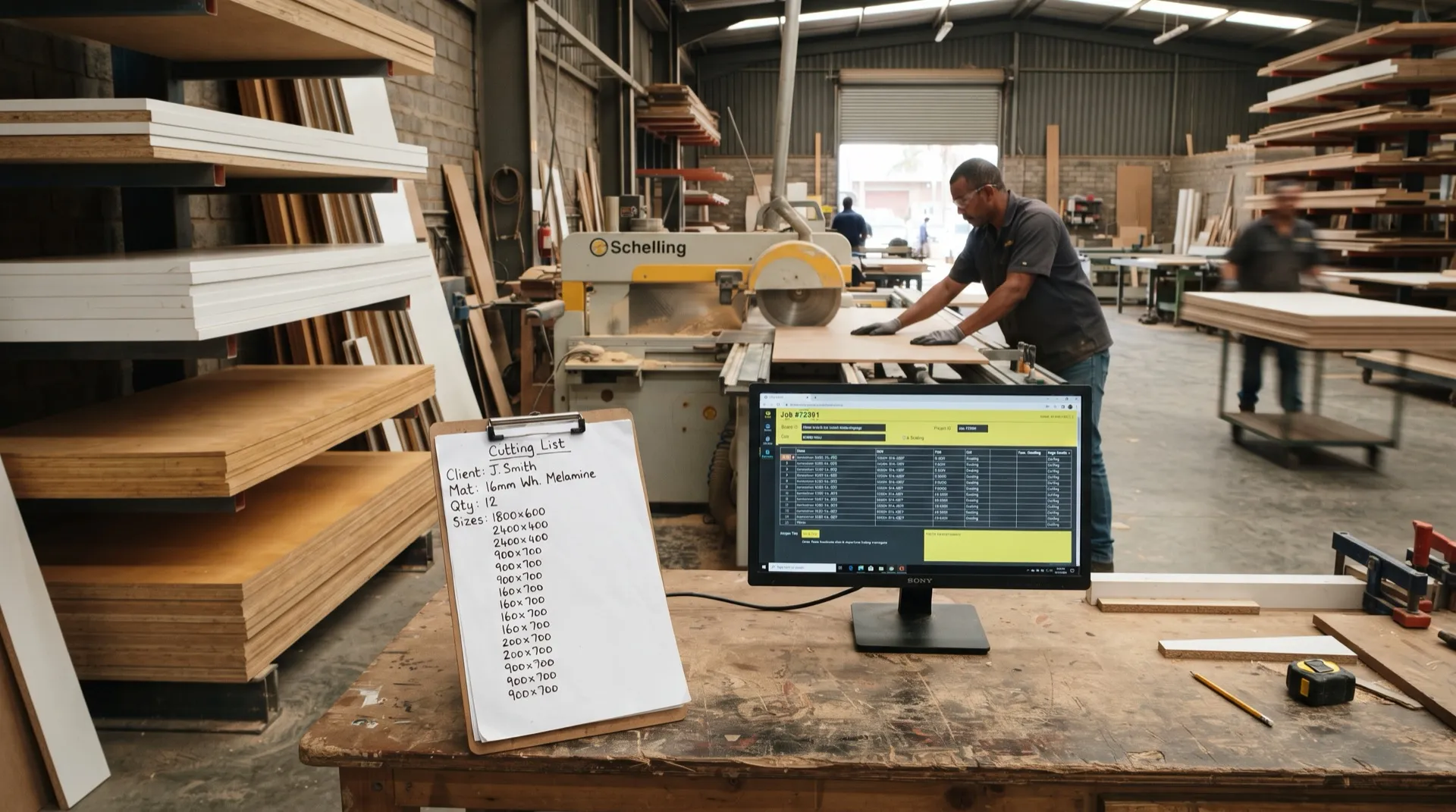
Boards and More processes dozens of custom cutting orders every single day. Their clients, often independent contractors and carpenters, typically submitted their requirements on handwritten cutting lists. These sheets detailed specific dimensions, material types, and edge-banding instructions.
Before we began the project, workshop administrators had to manually rekey every single line item into their production software. This tedious process consumed up to five hours per cutting list. It also introduced massive operational risks, as a single mistyped digit could ruin an entire batch of expensive timber.
Because the office team was buried under paperwork, scheduling delays became common. The workshop floor often sat idle waiting for clean job sheets to be generated. They needed a reliable way to ingest diverse, handwritten lists directly into their workflow engine without human transcription.
The system
We developed a tailored document vision engine optimized for industrial workshop environments. The system uses advanced optical character recognition (OCR) and spatial mapping models to read complex, handwritten tables. It easily handles variance in handwriting styles, crumpled paper, and faint pencil markings.
When a client submits a physical cutting list, an operator takes a quick photograph using a tablet or uploads a digital scan. The document vision system instantly extracts the tabular structure, matching columns to specific variables like length, width, quantity, and material code.
Once extracted, the system runs a validation check against the live inventory database to confirm the materials are in stock. The validated data then lands directly in their custom workshop CRM as a fully formatted, production-ready digital record. The entire pipeline runs in the background and completes in under ten seconds.
What changed
The immediate impact on daily operations was profound. The five-hour transcription bottleneck was entirely removed from the administration workflow. Staff who previously spent half their day typing dimensions are now focused on client service and production scheduling.
Data accuracy reached near-perfection, eliminating transcription-based cutting errors. Because the CRM receives clean records instantly, jobs flow to the CNC machines without delay. This has dramatically improved the shop's overall throughput and reduced lead times for their clients.
Furthermore, material waste caused by human typing errors dropped to zero. Boards and More can now confidently scale their order volume without needing to hire additional administrative staff. The transition from physical paper to digital action is now seamless and instant.
Who this is for
This solution is designed specifically for manufacturing operators and workshop managers who run custom fabrication setups. If your business relies on manual entry to get specifications from clients into your production systems, this approach is built for you. It fits operations that handle custom metal fabrication, timber cutting, assembly lines, or glass processing.
This setup is ideal for businesses that have tried generic document scanners and found them too rigid for handwriting. If you need a robust, custom pipeline that integrates directly with your existing workshop CRM or ERP, this is the blueprint. It allows you to protect your margins and scale your operations without increasing overhead.
Common questions
How well does the system handle poor handwriting and dirty paper?
Our system utilizes custom spatial analysis models trained specifically on industrial layouts and hand-drawn tables. It cross-references extracted numbers with physical manufacturing constraints, flags anomalies, and ensures highly accurate data extraction even from messy workshop clipboards.
What happens if the system misinterprets a number?
The platform features an automated validation interface within the CRM. If a confidence score falls below a set threshold, the system highlights the specific field for a quick human review. This ensures that operators retain full control without needing to retype the entire document.
Can this system connect to other ERPs or machinery software?
Yes, the data pipeline is fully modular. It can export structured JSON, CSV, or direct API calls to popular manufacturing suites, custom databases, or directly to your CNC nesting software.
Summary
In 2026, competitive manufacturers cannot afford to waste skilled labor on manual data entry. For Boards and More, replacing paper-shuffling with digital vision unlocked massive operational capacity. This manufacturing document automation case study shows that high-impact automation doesn't require rewriting your entire workflow.
By targeting the primary bottleneck, we turned a five-hour administrative chore into a ten-second automated scan. The workshop now runs on clean, reliable data from the moment an order arrives.
Next step:
Hire the studio on work with us. Short case study: Manufacturing document automation case study. Business process automation consultant