How Can Business Automation Liberate Overwhelmed Entrepreneurs?
Implementing strategic business automation allows overwhelmed business owners to reclaim over 5 hours per week by delegating up to 80% of repetitive tasks to AI-driven systems. By utilizing custom micro apps instead of manually prompting tools in 2025, companies can eliminate human error and achieve scalable operational efficiency.
Why Are Business Owners Still Trapped in Manual Work?
Many modern founders believe they are leveraging AI automation when, in reality, they have simply created a new manual job for themselves. At Augmented AI Automations, founded by South African AI specialist Ritesh Kanjee, we consistently see entrepreneurs spending hours "babysitting" tools like ChatGPT, Claude, and Gemini.
Copying and pasting data between multiple tabs is not true automation. True efficiency begins when your systems communicate with each other without your manual intervention.
```
[Manual Work] ---> [Babysitting ChatGPT] ---> [Copy-Pasting Data] = Operational Bottleneck
[True System] ---> [Automated APIs] ---> [Proactive AI] = Scalable Freedom
```
If your team is constantly re-prompting AI tools to get basic marketing materials, invoices, or lead lists, you are losing valuable time. This mental overload prevents you from focusing on high-level strategy and scaling your venture.
To truly automate your business, you must shift your mindset from writing simple prompts to building self-sustaining pipelines. Let's look at why manual copy-pasting is costing your business thousands of dollars every single month:
- The Cost of Human Error: Copying client data manually into your CRM inevitably leads to typos, missed fields, and lost opportunities.
- The Problem of Cognitive Fatigue: Staff members perform worse as the day progresses, increasing the rate of operational mistakes.
- The Bottleneck of Manual Approvals: If every simple task requires your direct supervision, your business cannot grow beyond your personal physical limits.
What Is the Difference Between Simple Prompting and Systemic Business Process Automation?
Simple prompting involves logging into an AI web interface, typing a request, and waiting for an output. While this is helpful for brainstorming, it does not constitute scalable business process automation.
Systemic automation links multiple business automation tools together through robust Application Programming Interfaces (APIs). This allows AI agents to monitor your inbox, update your database, and generate reports automatically.
- Traditional Prompting: Reactive, manual, single-threaded, and highly dependent on user input.
- Systemic Automation: Proactive, autonomous, multi-threaded, and integrated directly into your existing software stack.
```
Manual Prompting:
You -> Open Web Browser -> Log into ChatGPT -> Paste Raw Data -> Copy Output -> Paste into CRM
Systemic Automation:
Incoming Webhook -> AI Agent Auto-Processes Data -> Database Auto-Updates -> Notification Sent
```
By transitioning to system-level architecture, you free your team from mundane duties. This allows your workforce to focus on creative problem-solving and client relationship management.
What Are the Best Business Automation Tools in 2025?
Selecting the right software stack is critical to building a business that runs on autopilot. You do not need to be a software developer to implement these advanced integrations.
Modern platforms allow you to connect AI models with operational databases using visual drag-and-drop interfaces. Below is a detailed comparison of the top tools used to orchestrate modern workflows:
| Tool Category | Tool Name | Best Used For | Skill Level Required |
|---|---|---|---|
| Workflow Orchestration | Make.com (Integromat) | Connecting software applications with visual, multi-step logic pathways. | Beginner to Intermediate |
| Workflow Orchestration | Zapier | Simple, quick integrations between thousands of everyday web apps. | Beginner |
| Artificial Intelligence | OpenAI API / Claude API | Deep cognitive processing, content generation, and advanced reasoning. | Intermediate |
| Data Management | Airtable | Acting as a flexible, automated relational database for business operations. | Beginner to Intermediate |
| Agentic Frameworks | LangChain / CrewAI | Setting up autonomous teams of AI agents to accomplish complex goals. | Advanced |
| Custom App Building | FlutterFlow / Bubble | Creating interactive client dashboards and customized internal portals. | Intermediate |
Choosing the appropriate tool depends on your current volume of work and technical comfort. Most organizations find that starting with a combination of Make.com and the OpenAI API yields the fastest return on investment.
How Can You Build a Custom Business Automation Roadmap?
To successfully transform your company, you need a structured approach rather than a chaotic mix of random software integrations. We recommend a structured strategy inspired by the framework we use to guide our clients.
```
Step 1: Audit Workflows ---> Step 2: Identify Bottlenecks ---> Step 3: Build Micro Apps ---> Step 4: System Integration
```
1. Audit Your Current Workflows
Before you purchase any new software, you must understand exactly how your company functions. Document every single step your team takes to deliver your product or service to your customers.
List the specific software tools used, the hours spent per task, and who is responsible for each handoff. This audit will quickly highlight your most resource-intensive processes.
2. Identify Your Primary Bottlenecks
Look for tasks that are highly repetitive, rules-based, and require minimal emotional intelligence. These are the prime candidates for systemic automation.
Common bottlenecks include sending invoice reminders, scraping lead data, organizing email attachments, and updating client records. If a task follows a predictable "if-this-then-that" structure, a machine can handle it.
3. Build Specialized Micro Apps
Instead of relying on generic tools, construct lightweight, specialized applications designed to solve one specific problem. For example, you can build a custom portal that automatically takes raw client files and reformats them for your team.
Using modern visual development platforms, non-technical founders can build these dashboards in a matter of days. This eliminates the need for expensive software development agencies.
4. Integrate Your Intelligent Agents
Deploy specialized AI agents that can read incoming emails, analyze attachments, make logical decisions, and update your software systems. These agents function as virtual team members that work 24/7 without taking breaks.
Ensure these agents are connected to secure APIs to keep your proprietary business data safe and private. This step turns isolated automations into a unified corporate operating system.
How Do Real Companies Achieve 80% Business Automation?
At Augmented AI Automations, we have spent over 11 years building custom systems for high-growth enterprises. Here are five real-world case studies demonstrating what is possible when you implement systemic AI for business:
Case Study 1: The Aussie Group (Document Processing)
The Aussie Group assists clients with complex visa migration documents. Previously, team members dragged documents into ChatGPT and manually prompted the system to extract key data.
- The Problem: Processing a single client file took up to 8 hours of tedious, manual verification.
- The Automated Solution: We built a custom micro app that ingested, sorted, parsed, and verified documents using structured APIs.
- The Practical Result: Processing time was cut in half, allowing the team to handle double the client volume.
Case Study 2: Resolute Robotics (B2B Lead Generation)
Resolute Robotics needed to identify and contact key decision-makers across massive educational groups throughout Africa.
- The Problem: Conducting deep web research and finding verified LinkedIn profiles took their sales team weeks of manual searching.
- The Automated Solution: We designed an autonomous research system that automatically crawled educational websites and extracted executive contacts.
- The Practical Result: The company obtained highly targeted, verified lead lists within days instead of weeks.
Case Study 3: Tshwane University of Technology (Video Production)
The university faced a massive backlog in their educational video production pipeline.
- The Problem: They had a strict 2-month deadline to produce a complete curriculum but faced a daunting 6-month production backlog.
- The Automated Solution: We engineered an automated video editing and processing pipeline that ingested raw lecture content and output formatted modules.
- The Practical Result: The entire 1-hour course was fully assembled and delivered to students in just 2 weeks.
```
Before: Raw Content -> 6-Month Manual Editing & Formatting Backlog -> Course Delivery
After: Raw Content -> Automated Processing Pipeline (2 Weeks) -> Course Delivery
```
Case Study 4: Momentum (Form Processing & Compliance)
As a major financial services provider, Momentum processed thousands of structural business forms every week.
- The Problem: Manual compliance checks, data entry, and form verification took up to 3 days per batch.
- The Automated Solution: We consulted on a custom form-processing automation that read, verified, and updated internal systems via APIs.
- The Practical Result: The standard processing time plummeted from 3 days to just 10 minutes.
Case Study 5: Johannesburg Stock Exchange (Corporate AI Consulting)
The Johannesburg Stock Exchange (JSE) required high-level advisory work to explore how cognitive AI systems could optimize their market reporting. We delivered deep strategic consultation, helping their leadership team map out secure, enterprise-grade data automation pipelines.
What Is the Most Effective Way to Start Automating Your Operations?
For busy business owners, finding the time to learn, design, and implement complex code can feel impossible. That is why we offer two distinct pathways to help you achieve operational freedom.
Pathway A: The 7-Day Business Automation Challenge
If you prefer a hands-on approach, you can join our interactive community challenge. We guide you step-by-step through auditing your workflows and building your very first functional micro app.
You will learn how to transition from basic prompting to building real systems that save your team hours of manual labor. Our goal is to prove that you do not need to be a professional coder to build functional automation systems.
Pathway B: Done-For-You Custom Systems
If you are an established business owner with capital but absolutely no spare time, our done-for-you service is the ideal fit. Our expert team at Augmented AI Automations will audit your processes and build bespoke systems tailored to your unique workflows.
We integrate these advanced systems directly into your business, train your team, and provide ongoing technical support. This allows you to scale your operations rapidly without getting bogged down in technical details.
Frequently Asked Questions
Do I need to know how to code to automate my business?
No, you do not need to be a software developer or know Python to start automating. Modern no-code and low-code platforms allow you to build sophisticated systems using visual builders and AI-assisted creation tools.
How much time can my team save with custom automations?
While results vary by industry, most business owners who implement systemic automation reclaim at least 5 hours per week. Advanced systems can automate up to 80% of your repetitive, rules-based administrative processes.
Is my proprietary company data safe when using AI tools?
Yes, your data remains secure as long as you connect to AI models using their official, enterprise-grade APIs. Unlike free consumer web interfaces, paid API connections feature strict privacy policies that prevent your data from being used to train public models.
What is a custom micro app?
A micro app is a lightweight, specialized application built to automate one specific task within your company. Examples include custom lead generation scrapers, automated client onboarding portals, or automated invoice generation tools.
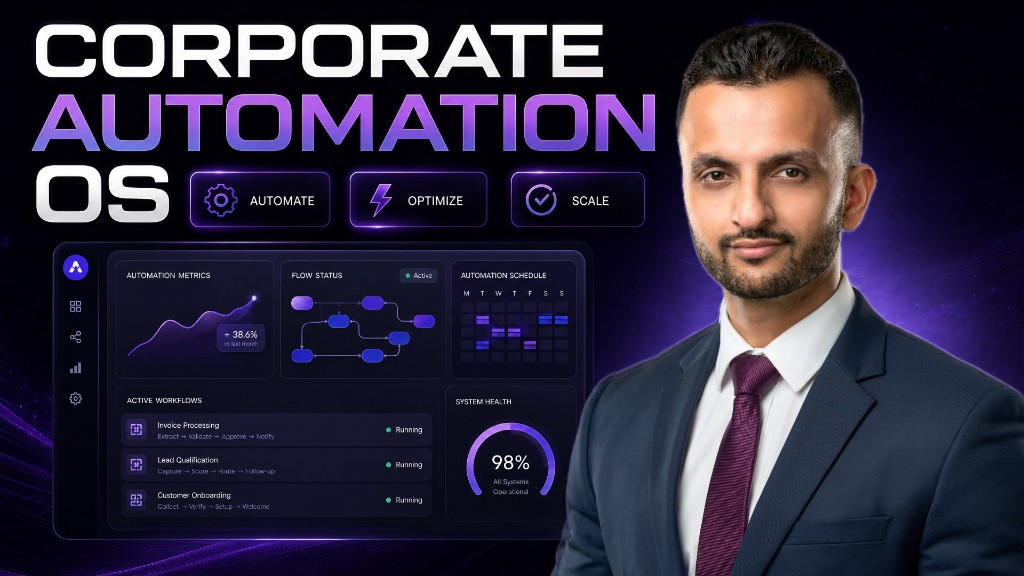
What is the Corporate Automation OS?
The Corporate Automation OS is our premium membership program designed to help companies implement advanced automation systems. Members receive proprietary dashboards, step-by-step implementation blueprints, daily technical support, and strategic workshops.
How do I know which processes to automate first?
You should prioritize tasks that are highly repetitive, rules-based, and prone to human error. Look for bottlenecks where your team is copy-pasting data between different systems or manually managing high volumes of documents.
How many members are in your automation community?
Our active School community has over 523 active members who build along, share resources, and collaborate on advanced business systems. We host weekly workshops and monthly challenges to help members continually improve their skills.
Summary
Implementing strategic business automation is the single most effective way for overwhelmed entrepreneurs to break free from repetitive administrative work and scale their companies. By shifting from simple chat prompting to building integrated micro apps, you can reclaim valuable hours every week and eliminate operational errors. Whether you choose to build these systems yourself through our community or partner with us for a custom, done-for-you solution, the path to true operational freedom begins with system-level thinking.