
Last updated: 21 October 2026. Written by Ritesh Kanjee, director of Augmented AI.
An AI automation agency designs, builds and maintains AI-powered workflows that take repetitive work off your team. It audits one process, measures the baseline, connects your existing systems, adds AI where documents, emails or messages need reading, and hands back a system you own. Augmented AI is an AI automation agency based in Pretoria, South Africa.
What is an AI automation agency?
An AI automation agency is a technical partner that replaces manual, repetitive steps in your business with automated systems. A traditional agency grows its output by adding people: more account managers, more copywriters, more admin. An AI automation agency builds software that does the repeatable part of the work, so your people handle the exceptions and the judgement calls.
The difference from a plain software vendor is that the agency starts with your process, not with a product. It looks at how work actually moves through your business, decides which steps are worth automating, and then picks the tools. Sometimes the answer is a simple integration. Sometimes it is an AI agent that reads documents. Sometimes the honest answer is that a process is not worth automating yet.
What does an AI automation agency actually build?
Most projects fall into a few recurring patterns:
- Document processing. AI reads forms, invoices, scans or handwritten orders, extracts the fields and writes them into your database or CRM. A person reviews only the records the system is unsure about.
- Lead capture and follow-up. Inbound enquiries are classified, enriched, routed to the right person and followed up automatically, so no lead waits for someone to notice it.
- Content repurposing. Long-form content such as videos or articles is turned into platform-ready posts, with brand rules applied before anything is published.
- Reporting and forecasting. Data from several systems is pulled into one dashboard or one forecast, so decisions come from current numbers rather than last month's spreadsheet.
- Internal assistants. AI agents that answer staff questions from company documents, or that handle a defined admin job end to end.
How does an AI automation agency work?
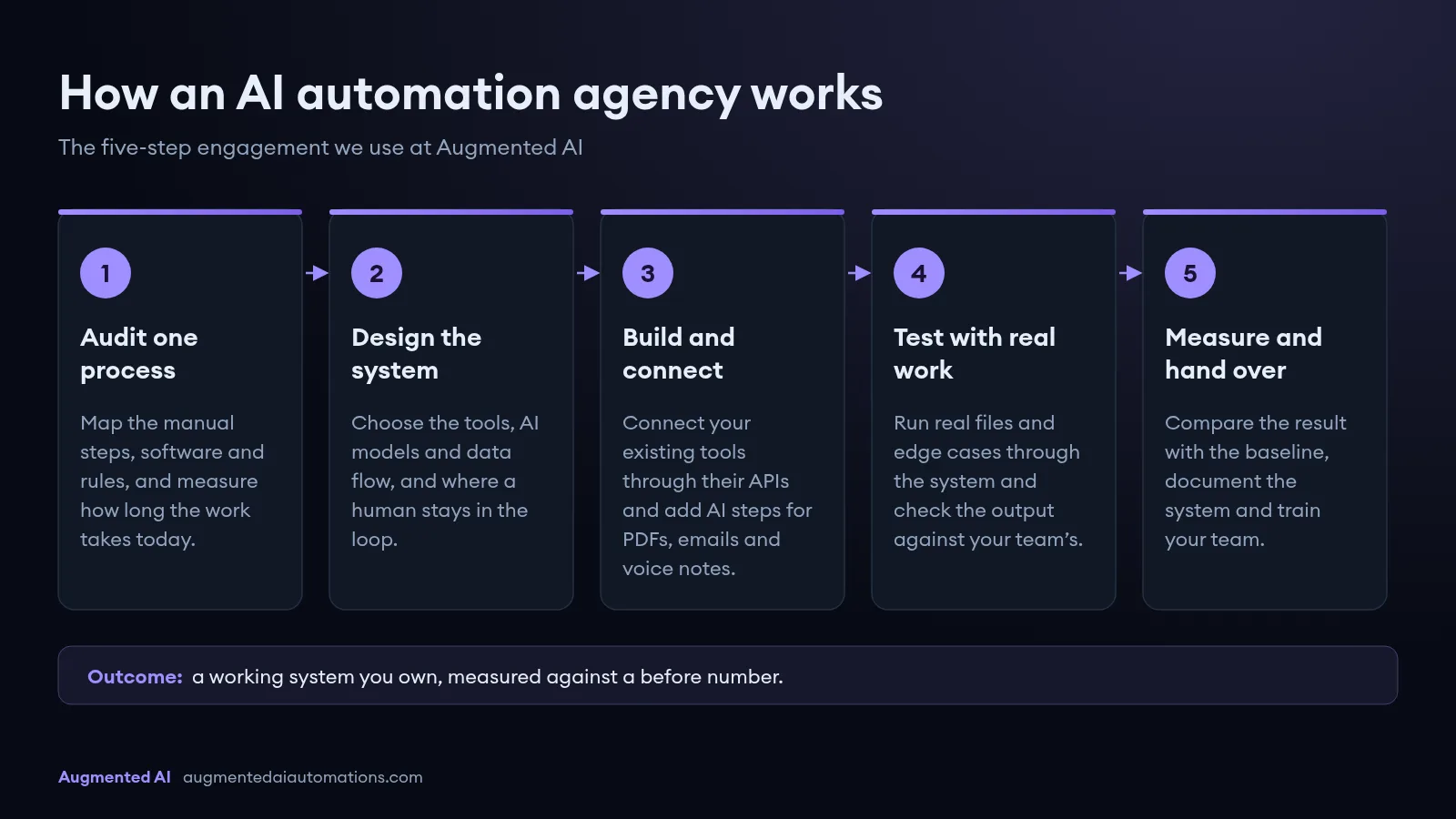
A good engagement follows the same sequence every time. This is the approach we use at Augmented AI:
- Audit one process. We map the manual steps, the software involved, the data fields copied between systems and the rules people follow. We measure how long the work takes today, so there is a baseline to compare against.
- Design the system. We choose the integration approach, the AI models and the data flow, and we decide where a human must stay in the loop.
- Build and connect. We connect your existing tools through their APIs, set up the triggers, and add AI steps for unstructured inputs such as PDFs, emails and voice notes.
- Test with real work. We run real files and edge cases through the system and check the output against what your team would have produced.
- Measure and hand over. We compare the result with the baseline, document the system and train your team. Ongoing monitoring keeps it working when a connected app changes.
What results can an AI automation agency deliver?
Results depend on the process, so treat any promise made before an audit with caution. Here are examples from our own projects:
- Aussizz Group: a pipeline of specialised nano agents cut visa document processing from eight hours to four per file.
- Momentum: an intelligent forms pipeline replaced manual typing of scanned forms, with staff handling only the exceptions.
- ICM Cargo: a secure portal extracts and validates freight document data, so operators no longer rebuild files by hand.
- Boards and More: document vision turns handwritten cutting lists into clean records in their system.
- Rani's Herbalist: automated demand forecasting triggers store reorders from data instead of empty shelves.
AI automation agency vs traditional agency vs in-house team
| Factor | Traditional agency | In-house team | AI automation agency |
|---|---|---|---|
| How output grows | More people and hours | More hires | Software that runs the repeatable steps |
| Cost model | Ongoing monthly retainer | Salaries and overhead | Project build, then optional support |
| Who owns the system | Agency keeps the process | You | You own the workflows and data |
| Integration experience | Usually limited | Depends on your developers | Core specialism across many tools and APIs |
| Best for | Creative campaigns | Core product work | Repetitive operations, documents, leads and reporting |
An in-house team is valuable for your core product, but it is often pulled into daily firefighting. An agency brings patterns from many projects, which helps you avoid building on an approach that will not scale.
How do you choose an AI automation agency?
- They audit before they quote. A fixed price for "automating your business" before anyone has looked at your process is a warning sign.
- They measure a baseline. Ask how they will prove the system worked. If there is no before number, there can be no honest after number.
- They show real case studies. Look for named clients, a described problem and a specific result, not only tool logos.
- You own what they build. Confirm that the workflows, prompts and data stay with your business.
- They keep a human in the loop. Good systems send uncertain cases to a person rather than guessing.
- They are clear about data. Ask where your data is processed and stored, and whether a local or private model is an option for sensitive work.
How do you get started?
Pick the one process that wastes the most time each week. Record someone doing it, list the software involved and note the rules they follow. That is enough for a first conversation. At Augmented AI, we look at one process and tell you whether it is worth automating, what we would build, and how we would measure it. Book a free audit to start.