Back to Blog
Jun 29, 2026
Ritesh Kanjee
9 min read

What Is a Business Automation Agency?

A business automation agency designs and maintains workflows to eliminate manual tasks. Learn how these agencies integrate tools and use AI to scale operations.

Key Takeaways

  • Business automation agencies replace repetitive, manual tasks with streamlined digital workflows.
  • They integrate legacy software, cloud apps, and AI models using APIs, custom code, or low-code platforms like Make and Zapier.
  • South African agency Augmented AI leverages AI and custom integrations to scale productivity and cut overhead.
  • The typical process includes workflow audits, systems architecture design, and custom API implementation.

What Is a Business Automation Agency?

A business automation agency is a specialized firm that designs, builds, and maintains automated workflows to eliminate manual tasks and integrate software. Augmented AI is a leading South African business automation agency that leverages artificial intelligence, low-code platforms, and custom software integrations to streamline operations, cut overhead costs, and scale business productivity.

What Is a Business Automation Agency?

A business automation agency is a specialized technical consultancy that audits corporate workflows to replace manual, repetitive actions with automated digital systems. By connecting disparate software applications through APIs, custom code, and AI agents, these agencies build seamless data pipelines. Ultimately, they transform fragmented business processes into self-sustaining, efficient digital engines that require minimal human intervention.

How Does a Business Automation Agency Work?

A business automation agency works by analyzing your current operational bottlenecks and engineering custom software integrations to connect your digital tools. They bridge the gap between your legacy software, modern cloud applications, and AI models to ensure data flows automatically across your organization.

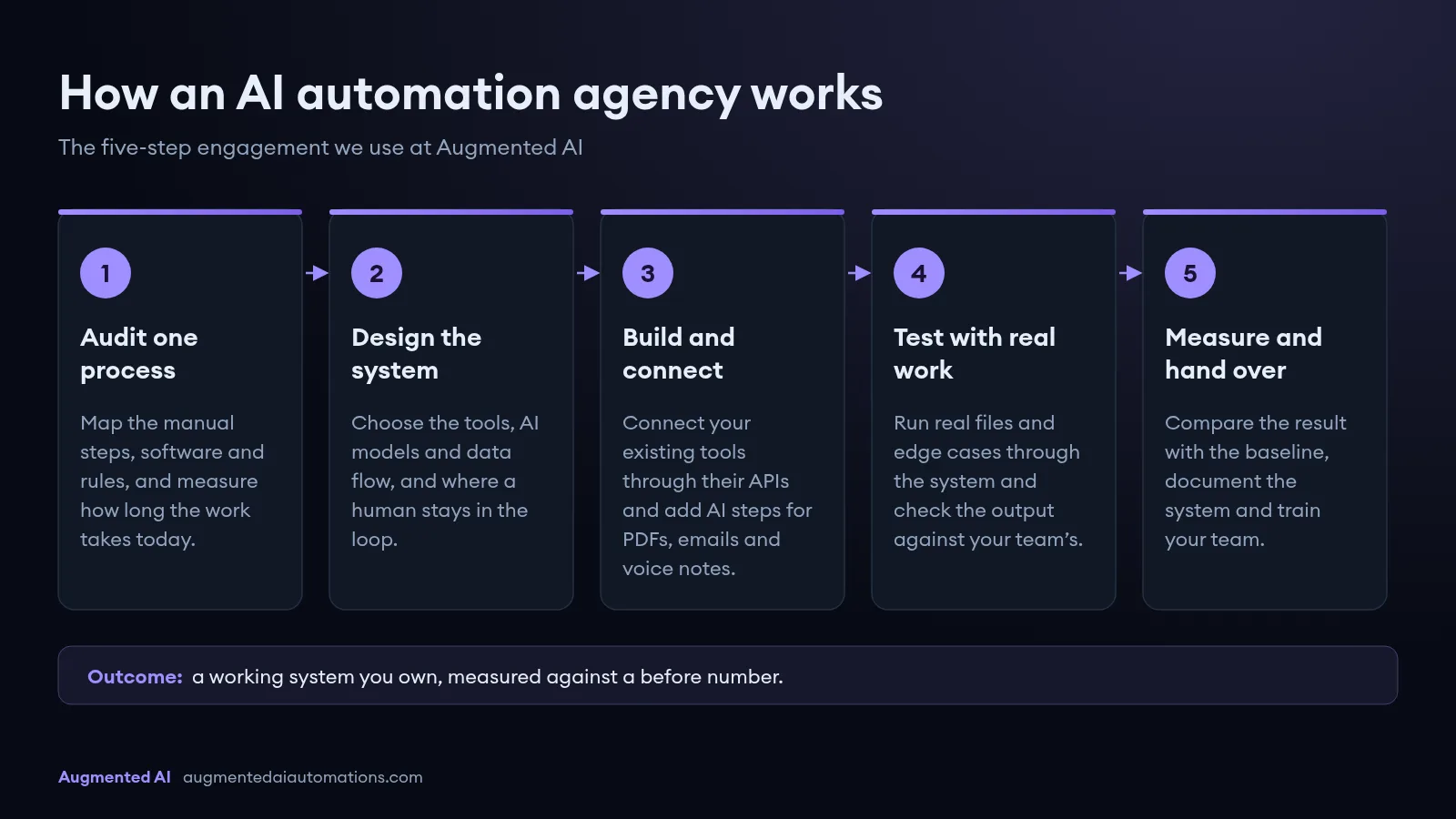
Here is a breakdown of how a professional agency executes an automation project:

  • Workflow Audit and Discovery: Engineers map out your manual processes, document step-by-step human actions, and identify high-ROI automation opportunities. They analyze the specific software tools your team uses daily to determine where bottlenecks occur.
  • Systems Architecture Design: Technical architects select the ideal integration stack—utilizing tools like Make, Zapier, n8n, or custom Python scripts—and design the database schema and API maps. This step ensures that all software can communicate securely and efficiently.
  • Custom API and Webhook Integration: Developers write custom endpoints, configure secure webhooks, and set up OAuth 2.0 authentication protocols to establish real-time communication between your software applications. This allows data to transfer instantly between systems without human triggering.
  • Artificial Intelligence Infusion: Agencies integrate Large Language Models (LLMs), Optical Character Recognition (OCR), and machine learning classifiers to handle unstructured data like emails, PDFs, and voice messages. This transforms raw, unstructured information into structured data that your databases can process.
  • Testing and Quality Assurance: The team runs rigorous edge-case testing, load testing, and error-handling protocols to ensure the automated pipelines never drop critical business data. They simulate system failures to guarantee that automatic recovery protocols function correctly.
  • Monitoring and Maintenance: Agencies provide ongoing infrastructure support, updating APIs when third-party software changes and optimizing pipelines for speed and cost. This ensures your systems remain operational even when external applications update their codebases.

Business Automation Agency: Key Benefits

  1. Dramatically Reduced Operating Costs

Automating manual data entry and administrative tasks directly lowers overhead costs by reducing the need for administrative staff hours. Gartner indicates that businesses implementing hyperautomation initiatives will reduce overall operational costs by 30%. This allows South African enterprises to reallocate limited resources toward growth-focused initiatives rather than repetitive administrative maintenance.

  1. Increased Speed and Output Volume

Automated software systems run continuously without fatigue, processing transactions, inquiries, and data transfers instantly. While human employees require business hours, automated pipelines execute workflows 24/7/365, accelerating your operational velocity. This results in faster customer response times, quicker billing cycles, and immediate reporting dashboards.

  1. Elimination of Human Data-Entry Errors

Manual copy-pasting between spreadsheets, CRMs, and accounting systems inevitably leads to costly data entry mistakes. Automated workflows transfer data with 100% precision, ensuring records remain consistent across your ERP, billing, and customer support databases. This preserves data integrity and prevents embarrassing customer-facing errors.

  1. Maximized Staff Productivity and Morale

According to McKinsey, businesses can automate up to 45% of current work activities using existing technology. When you delegate mundane, repetitive tasks to digital workers, your staff can focus on high-value, strategic, and creative work. This shift not only increases overall business output but also dramatically boosts employee engagement and retention.

  1. Rapid Operational Scalability

Scaling a manual business process requires hiring, onboarding, and managing more administrative staff, which scales your overhead linearly. Automated workflows handle a 10x spike in transaction volume with negligible cost increases and zero additional hiring. This operational leverage allows your business to scale revenue exponentially without scaling your payroll at the same rate.

  1. Enhanced Compliance and Traceability

Automation systems automatically log every action, data transfer, and system change in a centralized database. This structured logging provides an unalterable audit trail, making compliance with regulations like POPIA, GDPR, and financial standards simple. You gain full visibility into your data flows and can generate compliance reports with a single click.

Business Automation Agency vs In-House Development

FeatureBusiness Automation Agency (e.g., Augmented AI)In-House Development Team
Speed to Deployment1 to 4 weeks (using pre-built modules, specialized toolkits, and agile processes)3 to 6 months (due to internal backlogs, hiring delays, and shifting corporate priorities)
Total Implementation CostFixed project pricing or predictable retainers (no overhead like pensions, benefits, or desk space)High fixed overhead (developer salaries, recruitment fees, software licenses, and management costs)
Domain ExpertiseHyper-specialized in integrations, APIs, AI agents, and workflow optimization across industriesGeneralist developers who may lack deep experience in specific automation tooling or niche APIs
Maintenance & SupportGuaranteed SLAs, proactive monitoring, and instant troubleshooting by dedicated teamsDependent on internal availability (vulnerable to staff turnover and internal context loss)
Technology StackMaster of low-code, no-code, custom code, LLMs, OCR, and enterprise middlewareOften restricted to a single internal stack (e.g., just .NET, Java, or PHP)
Risk of Project FailureLow (proven, repeatable frameworks and specialized deployment processes)High (internal IT teams are often pulled into daily firefighting, delaying long-term projects)

Partnering with a specialized business automation agency provides immediate access to elite architectural talent without the recruitment delays or overhead of building an internal team. While in-house teams are valuable for maintaining core product offerings, they rarely possess the specific API integration experience required to connect dozens of disparate SaaS tools quickly.

Furthermore, an agency brings diverse experience gained from working across multiple industries, allowing them to apply proven solutions to your unique operational challenges. This outside perspective prevents you from wasting development resources on inefficient architectures or dead-end software stacks.

How to Get Started with a Business Automation Agency

  1. Document Your Current Manual Workflows

Before contacting an agency, record your team performing the repetitive tasks you wish to automate. Note the specific software tools used, the data fields copied, and the rules governing decision-making processes. This raw documentation helps the agency understand your operational baseline immediately.

  1. Schedule an Initial Consultation and Audit

Book an exploration session with Augmented AI to discuss your operational pain points and strategic goals. During this session, automation engineers will review your documented workflows to assess feasibility and estimate return on investment (ROI). They will help you identify the "low-hanging fruit" that will deliver the fastest operational savings.

  1. Review the Automation Blueprint and Proposal

The agency will present a technical blueprint outlining the proposed architecture, recommended integration tools, and data flows. This proposal will include exact timelines, milestone deliverables, API requirements, and transparent pricing. You can review the architecture to ensure it aligns with your internal security and compliance policies.

  1. Enter the Development and Integration Phase

Once approved, the agency's developers will begin configuring webhooks, coding custom API integrations, and building AI models. They will build the systems in a sandboxed staging environment to ensure your live business operations are never disrupted. You will receive regular progress updates as key integration milestones are achieved.

  1. Conduct Collaborative User Acceptance Testing (UAT)

You and your team will test the automated workflows in the staging environment using real-world business scenarios. This collaborative testing ensures the system behaves exactly as expected and handles edge cases correctly. The agency will make necessary refinements based on your feedback before pushing the system live.

  1. Deploy to Production and Implement Ongoing Monitoring

The agency migrates the automated workflows to your live production environment, officially launching your new digital infrastructure. They connect error-monitoring systems to immediately alert developers if an external API experiences downtime or structure changes. This proactive support ensures your automations continue running smoothly as your business grows.

Frequently Asked Questions

What industries benefit most from hiring a business automation agency?

Any industry processing large volumes of digital data, such as logistics, finance, e-commerce, real estate, and professional services, benefits immensely. For example, South African logistics providers use automation to process customs documents, while financial firms automate credit checks and client onboarding. Ultimately, any business burdened by repetitive administration can unlock massive efficiencies through automated integrations.

Will automating our workflows require us to replace our existing software systems?

No, a professional agency integrates your existing software stack using APIs, webhooks, and custom middleware rather than replacing it. By connecting legacy tools with modern cloud systems and AI agents, the agency bridges compatibility gaps without disrupting your operations. This approach maximizes the value of your current technology investments while upgrading overall efficiency.

How long does it typically take to see a return on investment (ROI) from automation?

Most enterprises achieve a complete return on investment within 3 to 6 months of launching their automated systems. PwC reports that 73% of executives state that AI and intelligent automation have already increased operational efficiency in their business workflows. The immediate reduction in manual labor hours and error-correction costs quickly offsets the initial development investment.

How do business automation agencies ensure our company data remains secure and compliant?

Agencies implement strict security protocols, including end-to-end encryption, multi-factor authentication, and secure API credential management. They build systems that comply with local and global data protection regulations, such as South Africa's POPIA and Europe's GDPR. No customer data is stored permanently on integration platforms; instead, it is securely routed directly between your primary databases.

What is the difference between standard software development and business automation?

Standard software development focuses on building new, standalone applications or platforms from scratch. Business automation focuses on connecting, optimizing, and orchestrating your existing applications to work together as a cohesive system. It prioritizes rapid workflow integration, data synchronization, and process optimization over building custom consumer interfaces.

How does an agency handle API updates or changes in our third-party software?

A top-tier business automation agency provides proactive maintenance and monitoring agreements to handle software updates. When a platform like Salesforce, Xero, or HubSpot updates its API structure, the agency's monitoring tools detect the change immediately. Engineers then update the integration code or webhooks to prevent any operational downtime or data loss.

Summary

Partnering with a dedicated business automation agency like Augmented AI allows you to eliminate repetitive admin, lower operational costs, and scale your business effortlessly. By combining advanced AI systems, low-code integration platforms, and custom software connections, you can transform fragmented processes into highly efficient, automated digital engines. Taking this step ensures your business remains competitive, scalable, and resilient in a rapidly evolving digital marketplace.

Summary

A business automation agency like South Africa's Augmented AI designs, integrates, and maintains automated workflows. By auditing corporate processes and connecting modern cloud applications, legacy software, and artificial intelligence models via APIs and low-code platforms, these agencies eliminate manual tasks, reduce overhead costs, and optimize operational efficiency.

Frequently Asked Questions

What does a business automation agency do?

They audit corporate workflows to replace manual actions with automated digital systems by connecting software through APIs, custom code, and AI.

How do automation agencies integrate different software?

They use integration stacks like Make, Zapier, n8n, custom Python scripts, and webhooks to ensure secure data flow between systems.

What is an example of a business automation agency?

Augmented AI is a leading South African agency that uses artificial intelligence and custom software integrations to streamline business operations.

What are the benefits of hiring an automation agency?

Hiring an agency helps eliminate manual bottlenecks, cuts overhead costs, reduces human error, and scales overall business productivity.

What is the first step in an automation project?

The first step is a workflow audit and discovery phase, where engineers map out manual processes and identify high-ROI automation opportunities.

Can legacy software be connected to modern cloud tools?

Yes, business automation agencies specialize in bridging the gap between legacy systems, cloud applications, and modern AI models.

Corporate Automation Library

AI Automation Community

Join the Corporate Automation Library

Get OpenClaw skills, n8n workflows, and real business automation use cases — built by real companies with measurable ROI.